
I’ve been banging the drum on AI being where some of the best opportunities in crypto are for years, with a renewed focus over these last few months. Back in Letter 93 I called x402 a “dark horse” for 2026. In Letter 95 I shared four low cap AI agent tokens I was watching. In Letter 99 I broke down the OpenClaw ecosystem and called the start of “AI Season, Take Two”. And more recently I’ve spent letters on setting up an AI agent and explaining how LLMs work.
I might have missed the mark on some exact tokens, and not every call was correct, but I firmly believe that everything has been at least directionally accurate. And I keep coming back to this stuff because I genuinely believe it’s where the puck is going. But until you actually look at the numbers side by side, it’s hard to appreciate just how dramatic the rotation has been over the past year and a bit.
So today I want to zoom out and walk through the data. The collapse of the memecoin sector, the quiet but steady growth of AI tokens, and what I think it means for how you should be thinking about positioning in 2026.
Let’s jump in.
The memecoin collapse
It’ll be no surprise to anyone that the memecoin sector has collapsed, but let’s take a look at the numbers to see just how much it has.
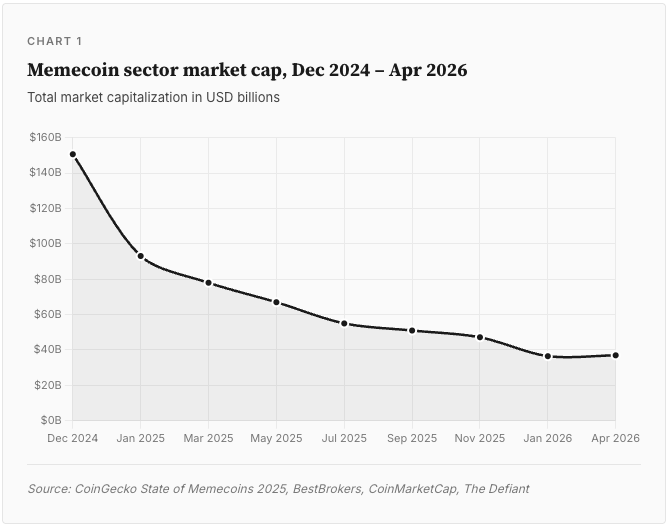
The memecoin sector peaked at $150.6 billion in December 2024, fueled by Trump’s re-election in November and the broader political frenzy. The TRUMP token launch in January 2025 felt like it marked the pico-top, but actually the sector was well into decline already by then. By January 2026 the sector had fallen to $36.5bn, roughly where it still sits today.
That’s a peak-to-trough drop of over 75% in 15 months. Bitcoin held above $93k for most of that period and even hit new ATHs, so memecoins didn’t collapse because crypto collapsed, they collapsed because the engine that powered them ran out of fuel.
The volume side is even uglier. Memecoin trading volume peaked near $20B per day in early to mid 2025 and by the end of the year it had dropped to under $3B.
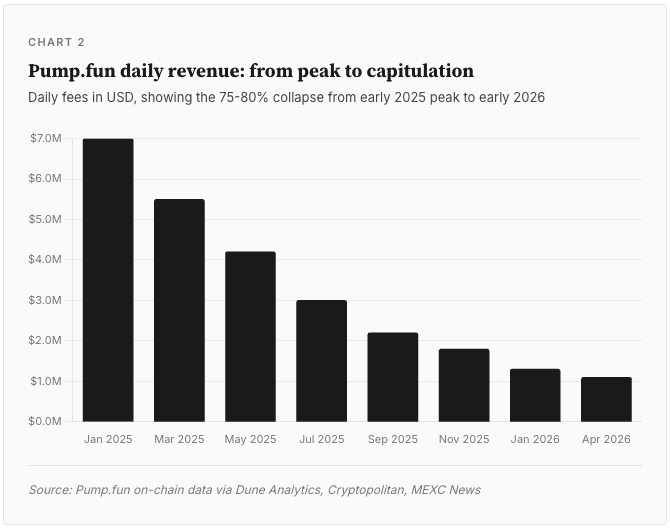
Pump.fun, the launchpad that powered most of the cycle, tells the same story from a different angle. Platform revenue collapsed from peaks of $7M+ per day in early 2025 to $1-1.5M per day by early 2026 (a number which still blows my mind tbh, it’s pretty insane that they’re still making that sort of money). But, that’s a 75-80% drop in fees, which aligns with the drops in overall marketcap and volume.
The other thing worth knowing about Pump.fun activity is that a lot of what was reported as “user activity” was never really human users to begin with. Dune Analytics dashboards from on-chain analyst @adam_tehc found that 93 out of the top 100 wallets by volume on Pump.fun are tagged as automated bots. The top wallets show 18+ hours of daily activity (which obviously isn’t human). Pump.fun’s founder Alon admitted that around 30% of all wallets on the platform have only ever made a single transaction, which he conceded are likely bots and AI agents.
So when you hear about the platform having “millions of users”, take it with a heavy grain of salt (a very good rule to follow for pretty much anything in crypto). A meaningful chunk of that activity is and was bots gaming the system to farm an airdrop that ended up never really materializing for them anyway (RIP).
The retail story is just as bad. According to a Dune dashboard tracking 1.4 million wallets that traded Pump.fun tokens, 96% either lost money or made less than $500 in profit. Out of 13.55 million wallet addresses across the platform’s lifetime, only 0.412% ever realized profits above $10,000.
Most people are probably better off buying a lottery ticket.
The token graveyard
I covered a lot of this in Letter 106 a few weeks ago, but it’s worth repeating because it’s genuinely staggering and it backs up the broader point. Over 13 million memecoins were launched in 2025. According to federal lawsuits filed against Pump.fun, 98% of those tokens collapsed within 24 hours of launch.
Less than 0.63% of Pump.fun tokens ever graduate to a real DEX. The other 99.37% die before they reach a $90k market cap.
Another thing to note is just how concentrated the sector is. DOGE and SHIB now make up 84% of the entire memecoin market cap, and honestly, when was the last time anyone got excited by either of those coins? Strip those two out and the rest of the sector — the long tail of every TRUMP, FARTCOIN, PIPPIN, and 13 million others — accounts for the remaining 16%.
So when people talk about the “memecoin sector,” what they’re really talking about is two coins from 2013 and 2020 plus a graveyard filled with Murad’s hopes and dreams.
A look at the AI side
While the memecoin sector was bleeding out, AI tokens did something different. They didn’t exactly skyrocket, and the story isn’t that AI tokens went to the moon while memes died. The story is that AI tokens grew steadily while memes died, and the gap between them has compressed dramatically.
In early 2025, the AI crypto sector was around $15B in market cap. Memecoins were peaking near $150B. The ratio was roughly 10:1 in favor of memes.
As of April 2026, the AI crypto sector sits at $22.6B, while memecoins sit at $36-38B. The ratio is now closer to 1.6:1.
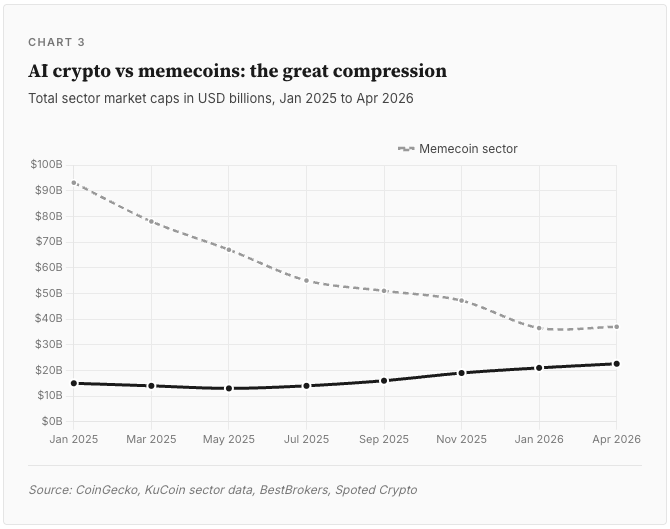
That’s a 6x change in the relative sizing of two of crypto’s biggest narratives.
And it tracks with what I’ve been seeing on the ground. When I wrote Letter 99 (AI Season, Take Two?) back in February, the thesis was that the first AI wave was full of glorified chatbots and the second wave would have actual revenue and utility behind it. The data backs this up, not with artificial pumps of AI Agents masquerading as memecoins, but with real products and companies slowly building up over time.
Why the institutions care about one and not the other
Institutional money has been telling us this story for months, with a huge amount of attention being paid to the Bittensor network and TAO token.
Some data points from Q1 2026:
Nvidia put $420M into TAO with 77% of the position staked
Polychain Capital added $200M in TAO exposure
Grayscale filed an S-1 to convert its Bittensor Trust into a spot ETF (ticker GTAO), with a decision expected by August 2026
Grayscale raised TAO’s weighting in its AI fund from 31.35% to 43.06%, the largest single-asset reallocation they’ve ever made
Bitwise also filed a TAO ETF in April
BitGo and Yuma launched institutional custody and staking for Bittensor subnet tokens
Now compare that to the institutional news for memecoins in 2026 «insert tumbleweed gif here».
The biggest story is that Pump.fun is reworking its fee structure to try to bring traders back, and that they’re facing federal lawsuits.
The institutions vote with money, and the money is telling you which direction this is going. Again, it’s not everything, and institutions get it wrong all the time, and god knows there are plenty of sectors within crypto that got billions of dollars of funding that are now gasping for air. But there’s also plenty of evidence that institutional money does support genuine growth (most notably with the Bitcoin ETF(s).
I think it’s important to consider the difference between crypto-native VCs shoveling money into things like gamefi, socialfi, the metaverse, NFTs, and other sectors that struggle, and non-crypto-native companies like Nvidia voting with their wallets / company treasury.
The infrastructure layer
This is the thing I keep coming back to and one of the reasons I’ve been so excited about AI tokens. I called this out in Letter 93 (Ten Predictions for 2026) talking about the x402 protocol, and in Little Learnings #1 where I broke down ERC-8004, the onchain agent identity standard.
But the agentic payments space has changed a lot since I first wrote about x402 a few months ago, and the picture is more nuanced now.
x402 is one protocol in a much bigger landscape
When I first wrote about x402, it felt like THE answer for how AI agents would pay each other. It was the first mover, it was elegant, and Coinbase had a head start. The lazy version of this letter would be to keep banging that drum.
The reality in April 2026 is that x402 is one of several competing protocols, and its early adoption numbers are softer than the hype suggested. Recent on-chain data from Artemis shows daily volume of only around $50k and daily transaction volume actually dropped over 92% from its December 2025 peak as bot-driven activity normalized.
That doesn’t mean the thesis is wrong or the protocol is bad, but it does mean the landscape has changed a bit and the winners are less clear.
Enter Stripe’s Tempo
The biggest development you should know about, that I haven’t covered yet, is Stripe’s blockchain Tempo and its Machine Payments Protocol (MPP).
Tempo is a payments-focused Layer 1 blockchain that Stripe and Paradigm incubated together. It launched mainnet on March 18, 2026, after raising $500 million at a $5 billion valuation in October 2025. The same day they went live on mainnet, they released MPP, an open standard for AI agents to pay for services using either stablecoins or fiat.
The partner list for Tempo is genuinely insane. Design partners include OpenAI, Anthropic, Shopify, Visa, Mastercard, DoorDash, Klarna, Revolut, Nubank, Standard Chartered, Deutsche Bank, and UBS (phew). DoorDash announced last week (April 21) that it’s using Tempo to power stablecoin payouts to merchants and dashers across 40+ countries, which seems like a pretty darn big deal?
For context, Stripe processes nearly $2 trillion (TRILLION) in annual payments. They acquired the stablecoin platform Bridge for $1.1B in 2024. They acquired the wallet provider Privy. They are not messing around.
How MPP differs from x402
The two protocols are similar at the surface level. Both are designed for machines to pay machines, both can settle in stablecoin, and both use the dormant HTTP 402 “Payment Required” status code under the hood. The design philosophies are where they differ:
x402 is permissionless and minimal. Pay per request. Each transaction settles individually. Anyone can run a facilitator. USDC on Base or Solana.
MPP adds “sessions”. An agent pre-authorizes a spending limit, then streams thousands of micropayments that batch-settle in a single on-chain transaction. Stripe describes it as “OAuth for money”.
MPP is rail-agnostic. It runs on Tempo today, but Visa has extended it for cards, Lightspark has extended it for Bitcoin Lightning, and Stripe has extended it for traditional payment methods. x402 is crypto-only.
MPP launched with 100+ integrated services already including Browserbase, Parallel Web Systems, Ramp, and more. It has Stripe’s entire merchant network behind it.
If x402 is the open-source crypto-native version of agent payments, MPP is the enterprise-ready corporate-backed version. They’re not the same product even though they look similar on paper.
And it’s not just two protocols
Once you start looking at this space, you realize there are at least five major agentic payment standards in play right now, plus card network extensions:
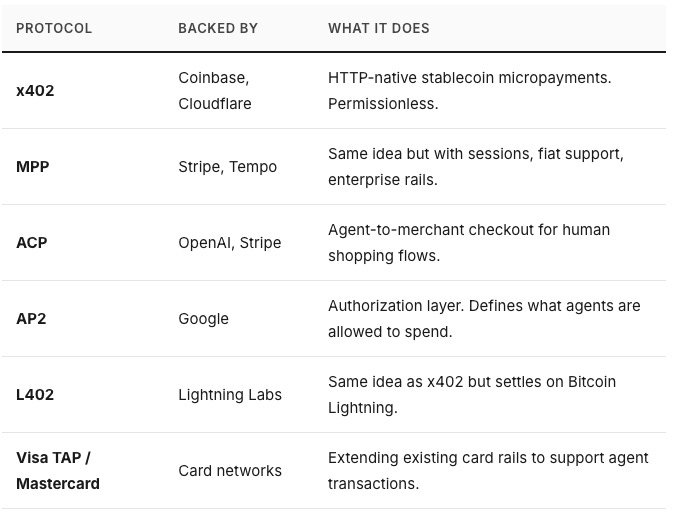
The good news is these protocols are mostly complementary, not competitive. AP2 handles authorization. ACP handles checkout. x402 and MPP handle settlement. A real-world agent workflow might use AP2 for spend governance, ACP for vendor discovery, and x402 or MPP for actual machine-to-machine payment execution. Google’s AP2 has already explicitly integrated with x402 for crypto settlement.
The bad news is this is messy and nobody knows yet which protocol will dominate which layer, so it’s a bit tough to make speculative investment decisions in this sector — other than a spray and pray approach (which tbh is not a terrible idea, betting on the overall sector eventually taking off).
How this changes the investment picture
Three things you should take from this.
The bullish case for the agentic payments narrative is even stronger than I previously framed it. When Stripe raises $500M for Tempo and signs DoorDash, Klarna, Mastercard, Visa, OpenAI, Anthropic, and Shopify as partners, that is the largest fintech in the world betting heavily on this. Combine that with what Coinbase is building, and what Google is building, and what Visa and Mastercard are building, and you have every major payments player aligned on agent payments being a big freaking deal.
The thesis is broader than the original idea of “buy x402-related tokens”. The bigger picture is that stablecoin volume hit $5.7 trillion in 2025 (double the previous year), B2B stablecoin payments surged 733% year over year, and Mastercard just paid $1.8B for the stablecoin firm BVNK. The “crypto rails for AI agents” narrative is part of a much broader “stablecoins are eating payments” story that has nothing to do with memecoins or even most altcoins. This is why I keep saying the AI/payments intersection is where the real opportunity is, not in chasing the next AIXBT or Fartcoin or whatever.
Tempo specifically is a project to keep an eye on, even though it doesn’t have a token yet. Stripe and Paradigm have explicitly said Tempo will transition from a permissioned validator set to a permissionless one over time. There’s a strong chance that means a token at some point. That would be one of the more interesting launches in the space if it happens.
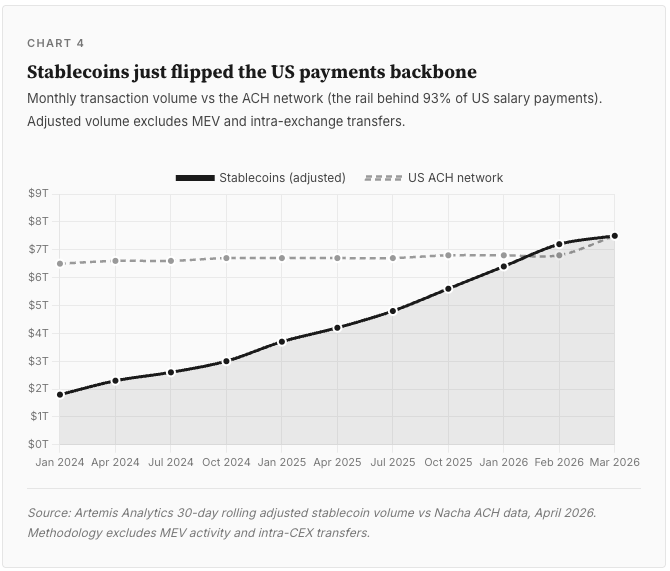
This is a pretty telling chart. In February 2026, stablecoin monthly transaction volume crossed the US ACH network for the first time ever, hitting $7.2T versus ACH’s $6.8T. And these are not the bot inflated raw numbers (which would put stablecoins at over $25T per year). This is Artemis’s adjusted volume that explicitly strips out MEV activity and intra exchange transfers.
If you don’t know what ACH is, it’s the rail behind essentially every US payroll, mortgage payment, and direct deposit. It’s been around since 1974. It processes roughly 29 billion transactions per year and roughly 93% of all American salary payments. It is the unsexy plumbing of the entire US economy. And it just got flipped by an asset class that didn’t exist 12 years ago… pretty mindblowing. To me it’s another great example of how fast things are accelerating in general in our world.
Visa and Mastercard understand this. That is why both are partnering with Tempo, integrating MPP, and signing up to the x402 Foundation. They would rather upgrade their infrastructure than be replaced by it.
So when I say I’m bullish on the AI infrastructure layer, I mean the whole stack of standards and rails being built right now to let agents transact autonomously. Some of it will be capturable through crypto tokens. Unfortunately (for us), a lot of it will be captured by Stripe, Visa, Mastercard, and corporate-backed L1s like Tempo. The protocol war is just getting started, and it’s going to be a very interesting space to watch.
The capital flow story
One more data point that puts this into context. In 2025, total crypto venture capital was $7.9 billion, up 44% year over year and almost half of that went into AI integrated blockchain projects.
BlackRock projects $5 to $8 trillion in AI capital expenditure between 2025 and 2030. Even a tiny fraction of that finding its way into decentralized AI infrastructure is more than enough to lift a $22bn sector materially.
By comparison, memecoin VC funding is essentially zero. There are no funds raising to invest in the next FARTCOIN (at least that I could find: if any funds are reading this with a flatulatory investment thesis, feel free to correct me).
Practical takeaways
The institutions are voting with their money
When Nvidia, Polychain, Grayscale, and the Linux Foundation all park serious money in the same sector, that’s a signal. When the other sector’s biggest news is federal lawsuits, that’s also a signal.
Memecoins still have a larger marketcap than AI tokens, but it’s concentrated, and the outlook isn’t looking so hot right now
DOGE and SHIB still make up 84% of the sector. The launchpad meta is down bad, and the odds are stacking against the millions of tokens trying to be the next FARTCOIN.
The AI sector is mostly noise too
There are ~900 projects with non-negligble market caps at the moment, and almost all of them will fail. Don’t mistake the broader narrative for an excuse to YOLO into AI memecoins. Letter 106 covered the brutal failure rates across crypto and AI tokens are no exception. Concentrate around the few names with real utility.
The agentic payment layer is the most interesting bet
This is bigger than just x402. Stripe’s Tempo and MPP, Google’s AP2, OpenAI’s ACP, plus card network extensions from Visa and Mastercard, are all converging on agentic payments. Watch the whole stack of standards and rails being built, not just one protocol.
Don’t assume the rotation is done
AI is at $22.6bn. Memes are at $36-38bn. If the trend continues at its current pace then the AI sector will overtake the Memecoin sector by the end of the year — hopefully as they both go up!
Closing thoughts
I’ve been saying for a while that AI is where some of the greatest opportunities in crypto are. Today we looked at the data to back that up in a really clear way. Capital is rotating from sentiment-driven assets to utility-driven ones, and the rotation has been quietly underway for over a year now.
Memecoins are a bet on attention. Attention is finite and rotates fast. AI tokens with real infrastructure are a bet on usage. Usage compounds. Over a long enough timeframe, the second one wins (attention will win any race in the short term, and ultimately attention is the thing that matters but the bet is that utility + usage will drive sustainable attention, whereas memetics based attention is shorter-lived).
That doesn’t mean every AI token is a buy. Most of them are still going to fail, just like nearly everything in crypto fails. But the sector itself has tailwinds that the memecoin sector simply does not have, and those tailwinds are real, sustainable, and getting stronger.
If you’re newer to AI agents and want to actually start playing with this stuff yourself, Letter 107 walks through how to set one up. Letter 108 covers how LLMs actually work under the hood. Both should help you build a better foundation for evaluating the projects in this space.
If there’s interest, I can do a deeper standalone piece on the agentic payments stack, breaking down x402 vs MPP vs ACP vs AP2 in more detail and which ones I think have the strongest setup. If that’s the kind of thing you want to read, lmk in the comments.
As always, my recommendation for most people remains the same: DCA into Bitcoin and a very small handful of other tokens, and wait. If you’re going to take some shots outside of that, I’d rather be taking those shots in AI than in the memecoin trenches in 2026.
Thanks for reading, hope you enjoyed this letter, and see you next week!
Disclaimer: The content covered in this newsletter is not to be considered as investment advice. I’m not a financial adviser. These are only my own opinions and ideas. You should always consult with a professional/licensed financial adviser before trading or investing in any cryptocurrency related product. Some of the links shared may be referral links.
Excellent.
Would love to read a deeper dive on agentic payment stacks
Have you seen what ledger are up to in this area? I think it’s super interesting and could be a layer that works with any of the protocols you mentioned
https://www.ledger.com/blog-2026-ai-security-roadmap