
One of the things I took from poker into investing is the habit of reviewing hands after the session ends, so I thought this week I would take a look at some of the tokens and projects I have mentioned over the last few months, and share some updated thoughts on them.
All five have featured in recent letters. $VVV (and its sibling $DIEM), $PHA, $CARDS, $PRISM and $ETHFI.
I'll look at where they were when I wrote about them, where they are now, what happened in between, and what I think happens next.
$VVV and $DIEM (Venice AI)
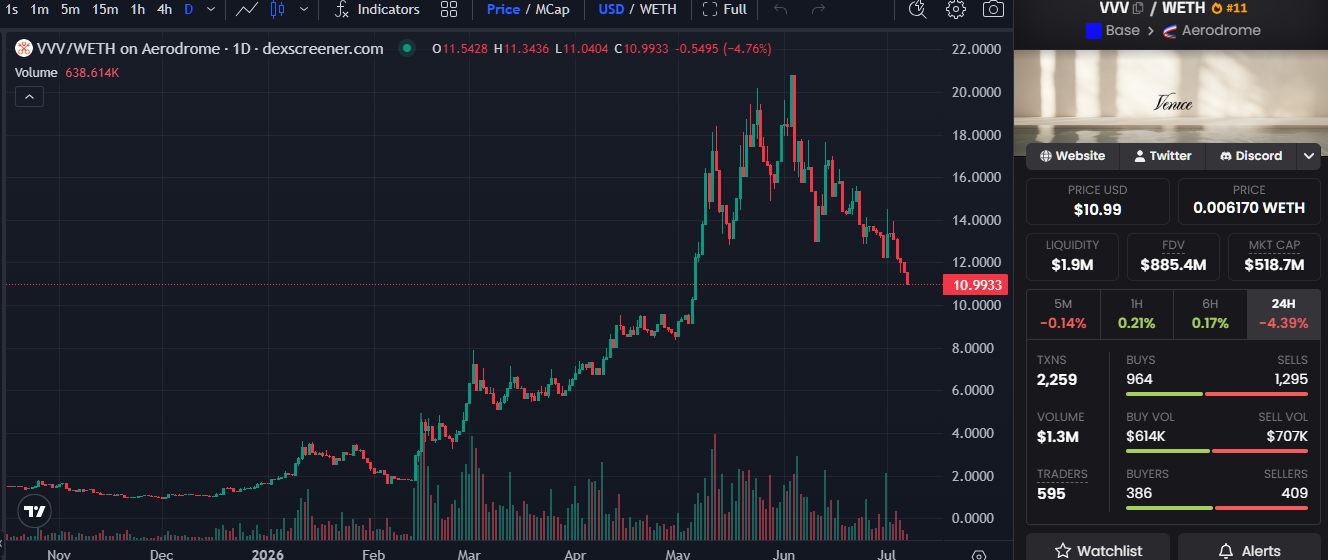
When I covered it: twice. Letter 102 in February at $6.64, then a full update in Letter 112 in mid May at around $17.39.
In Letter 112 I told you I was taking some profits off the table while keeping a long-term bag of both VVV and DIEM. Part of the reasoning: when the biggest podcasts and traders all start talking about something at once, it tends to mark a local top rather than an early entry.
Now: VVV sits around $11, market cap near $550m. Down roughly 33% from Letter 112, and still up roughly 76% on Letter 102. It printed a high of about $21.32 on June 3 before a significant retracement to where it is today.
A large part of that is due to the news that Venice closed a $65m Series A led by Dragonfly at a $1 billion valuation, structured as equity plus token warrants, with no sale from the treasury’s 30m+ VVV. Erik Voorhees has been on X defending the terms after critics argued the deal underprices the token. The debate worth watching is whether future value accrues to equity holders or token holders. Every crypto project raising equity faces this question eventually, and Venice is now facing it in public.
The supply side keeps tightening regardless. Emissions drop to 3m VVV per year this month, down from 10m at launch. The revenue-funded buy and burn continues, with burn rates doubled in April, and Venice V2 with text-to-video is on the roadmap.
DIEM sits around $1,310 with a $49m market cap, off its May 20 high of about $1,927 (near where it traded at the time of Letter 112). The mechanism is unchanged. One DIEM equals one dollar of Venice API credit per day, forever, minted only by locking staked VVV. At current prices the market pays roughly 3.7 years of compute upfront for perpetual access. New DeFi rails have appeared around it since the letter, including liquid staked DIEM (wstDIEM) and collateral markets on Morpho.
Looking forward: of everything in this letter, Venice has the most complete flywheel. Real revenue, shrinking supply, a second demand sink in DIEM, and now $65m of runway. The profit-taking call from Letter 112 aged well, with the price a third lower since. The pullback from $21 to $11.70 looks like froth coming out after a spectacular run from December. Still bullish, and still holding a solid position in both VVV and DIEM.
$PHA (Phala Network)
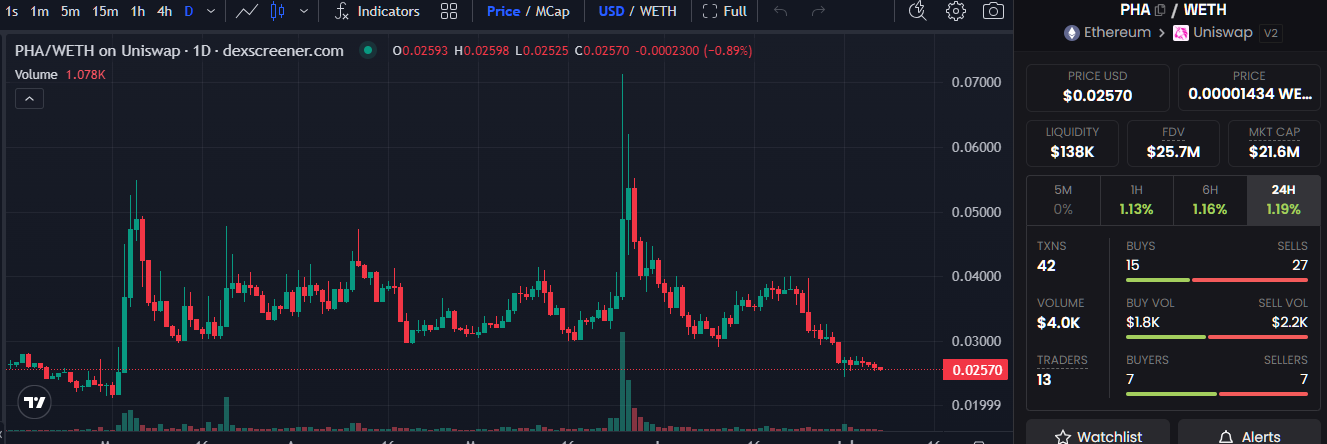
When I covered it (Letter 113, late May): around $0.03 to $0.04, market cap in the $30m to $40m range.
I did not pitch it as a high conviction buy. I framed it as a small, asymmetric bet on the confidential AI narrative, with a long time horizon and no expectation of a quick rerate. I told you to watch the metrics rather than the price. Token throughput on Phala Cloud, enterprise customer count, GPU TEE capacity.
Now: the token sits at around $0.026, market cap near $22m. Down roughly 25 to 30% since the letter, and it shed close to 14% in the past week alone.
The frustrating part is the business keeps doing business things. Since I wrote about them they added DeepSeek V4 Flash and updated Qwen models to the confidential compute catalog, and continued repositioning from crypto privacy project to enterprise AI infrastructure company. None of it helped the token.
Which brings me back to the core tension from the original letter. Phala’s revenue is mostly off-chain. Enterprises pay for confidential compute with credit cards through Stripe, and almost none of it routes to PHA holders through any on-chain mechanism. A real business sits next to the token rather than underneath it. Until something changes there (a buyback, a fee switch, anything connecting cloud revenue to the token), PHA trades on narrative alone. And right now there is no narrative bid (especially with Venice struggling and attention flowing to other sectors). I flagged the history of compute tokens like Render, Akash and Filecoin in the letter, all of which built real products while their tokens bled. So far PHA is following the script.
Looking forward: the thesis is intact and the token is cheaper. If the AI privacy narrative catches a bid, or the team announces a revenue-to-token mechanism, a sub-$25m market cap against a ~$3m ARR business rerates quickly. Without either of those, I expect more drift. This one is a patience trade, and patience trades test you.
$CARDS (Collector Crypt)
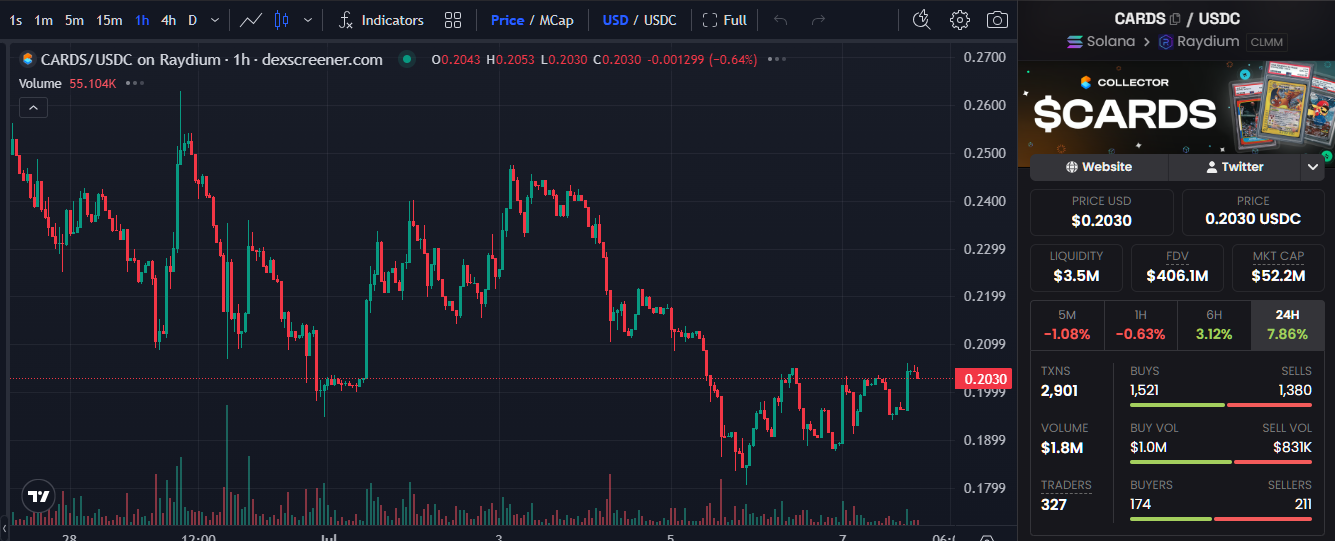
When I covered it (Letter 115, early June): around $0.21, market cap around $55m.
My take at the time: owning a tokenized card is a bet on the card. Owning CARDS is a bet on the business of selling packs. These are two different bets, and people are often confusing them. The bull case was the near 1x revenue multiple. The bear case was supply, with roughly three quarters of tokens still locked. For the airdrop hunters I pointed at the pre-token platforms instead, Phygitals, Beezie and Courtyard.
Now: the token is at around the same price, though it did hit an ATH of around $0.38 a few weeks ago — making for a pretty clean almost 2x if you took profits near there.
It’s been an eventful month. On June 23, Maelstrom (Arthur Hayes’ family office) published a bullish report on CARDS with a $4 price target (absolutely ludicrous target) but which still sent the token up 16% in a day and lit up the timeline. On the product side, a partnership with Loopscale will let people borrow USDC against vaulted card NFTs, and the team has flagged an on-chain tokenized cards index plus expansion into One Piece and sports cards.
The bear case from the original letter has not gone anywhere though. Roughly a quarter of supply circulates. There were token unlocks on June 29, and the next unlock is on July 29 and releases about 28.8m tokens (roughly $6m at current prices, 1.4% of total supply), with plenty more behind it. The gacha mechanic also lives in a regulatory grey zone between gaming and gambling, and the whole thesis leans on pack-ripping volume holding up.
That said, volumes are regularly hitting new highs and the TCG sector is still on fire so there’s still a lot of momentum behind it.
Looking forward: revenue remains real and the P/E style maths remains compelling relative to most of crypto. My read is the same as it was. You are buying a genuinely good business through a token with heavy dilution ahead of it. A good token to keep on a watchlist and buy when there are significant retracements and sell when the timeline gets overzealous about it.
$PRISM
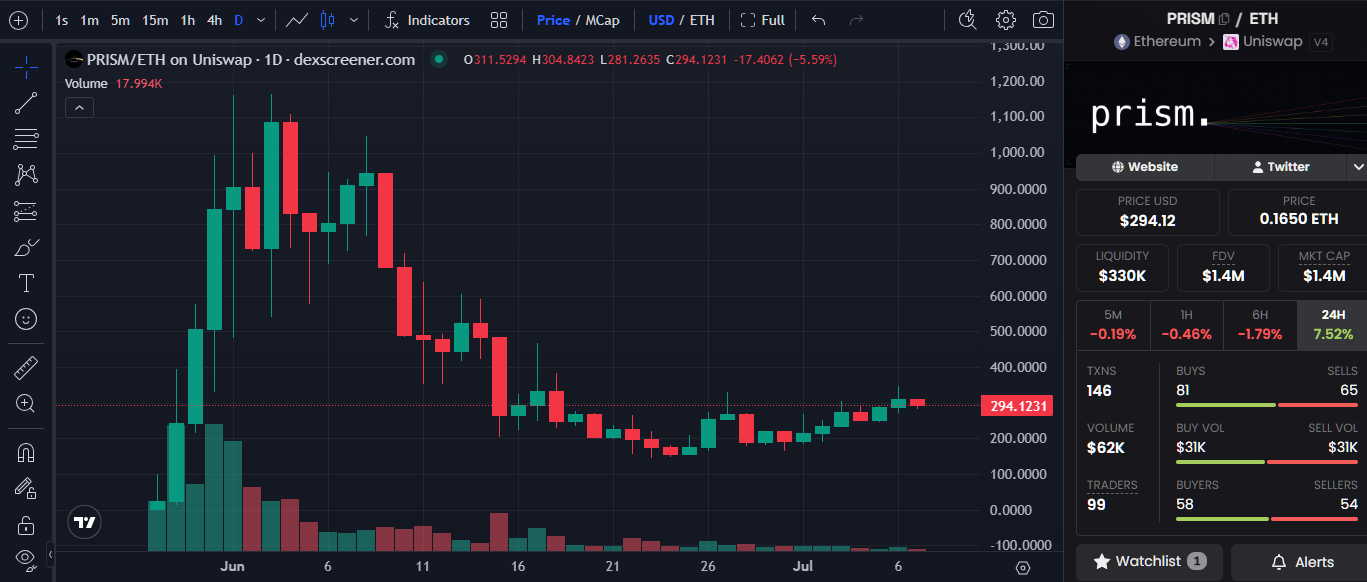
When I covered it (Letter 116, mid June): $242.91, with the market cap in the low single-digit millions.
I called it watchlist material, or one to take a longshot punt on. A small, eyes-open bet for people who enjoy cool onchain mechanics and funky new defi innovations and experiments.
Now: the token sits around $294, up roughly 20% since the letter.
The token had already been on a wild ride before the letter went out. It peaked above $1,100, then retraced hard, and I published with the price at ~$242. It’s been on a wild ride since too, yo-yo’ing all over the place. Fortunately, the market seems to be appreciating something about it and supporting the price for now at least.
Looking forward: Spectrum V2 ought to be launching any day now and a lot hinges on how things go there. It looks promising, but this is still a typical assymetrical bet for me — probably zero, but a good enough chance for it to be a hero.
$ETHFI (EtherFi)
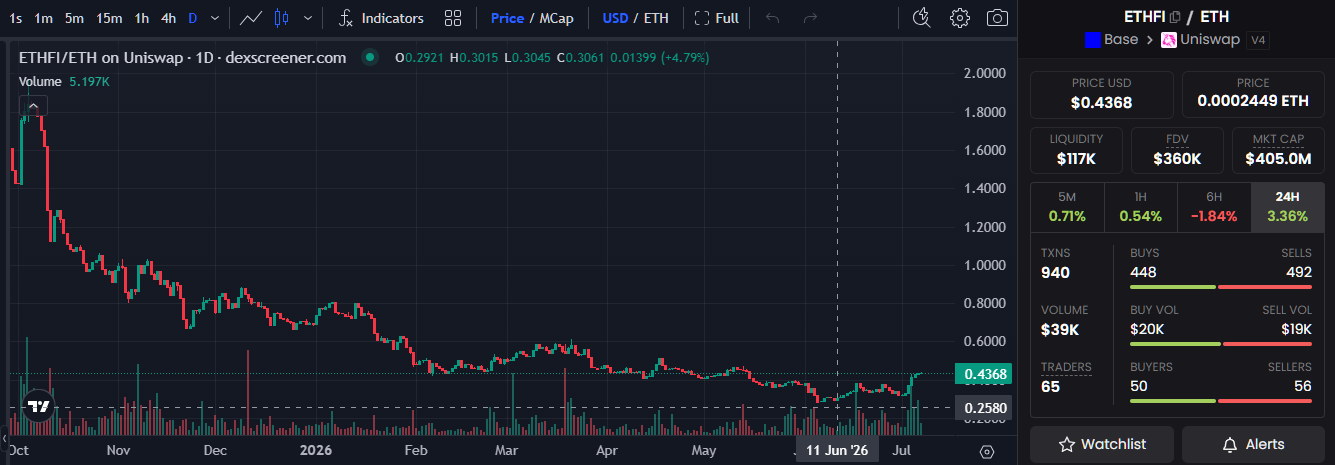
When I covered it (last week’s neobank letter): around the $0.30 mark.
I said if you want token exposure to the crypto neobank sector, consider both ETHFI and AVICI. The historical buybacks were the reason for ETHFI, plus the team flagging more token value to come in some other form.
Now: around $0.42 to $0.44. Up roughly 35% in the week since the letter.
I got lucky on timing here, plain and simple. Any time you are up 35% in a week there’s bound to be some luck involved, but hey, we’ll take it. The honest version is I wrote about a token near its lows with improving fundamentals, and the market happened to agree seven days later. Sometimes it’s 7 months later, sometimes it’s never.
What the market is waking up to is the value accrual machinery I covered. The business behind it holds up. DeFiLlama puts annualised protocol revenue around $34m, out of total fees above $150m. Messari’s February valuation report had a stat worth repeating for a neobank letter follow-up: Cash is now the largest revenue line at roughly half of protocol revenue, so the card already out-earns the staking business.
TVL sits in the billions, second among liquid staking protocols behind Lido, and the Cash migration to OP Mainnet moved $220m in TVL and 70,000 live cards without a single declined payment. As spending products go, this is the one with the most protocol behind it.
Looking forward: With around 93% of tokens in circulation, the unlock overhang is mostly nonexistent — the main reason I was enticed by the token last week. Of the crypto neobank plays with a live token, this remains my pick for cleanest alignment between business and holder. A 35% week does not change the thesis, it just makes it slightly less appealing to buy cause of the higher price. I bought more just yesterday though, so I think the price is still reasonable.
Final thoughts
Writing these recaps is always going to be a mixed bag. Anyone with a newsletter will happily show you their winners. The useful information lives in the full ledger, including what I said at the time, so we can look at our losses alongside our wins.
If I had to rank them on forward looking expected value today, knowing everything above: Venice and ETHFI share the top spot, CARDS comes next with the dilution asterisk in big bold font, and PHA and PRISM bring up the tail: PHA as the patience trade, and PRISM last as the lottery ticket.
As always, none of this is financial advice. I hold positions in some of these and my bags shape my views no matter how hard I try to stay objective. Do your own research, size for the possibility of zero on the small ones (or on all of them tbh), and be real with yourself about which of these is an investment and which is a punt.
In other words, try and be an investor, not a gambler.
As always, thank you for reading, and leave any questions or comments below :)
Disclaimer: The content covered in this newsletter is not to be considered as investment advice. I’m not a financial adviser. These are only my own opinions and ideas. You should always consult with a professional/licensed financial adviser before trading or investing in any cryptocurrency related product. Some of the links shared may be referral links.
Enjoyed reading this! It was a nice break from seeing $ANSEM on my X feed (happy for CT tho).
Curious to hear your thoughts on:
•OpenGradient $OPG
•WorldCoin $WLD