
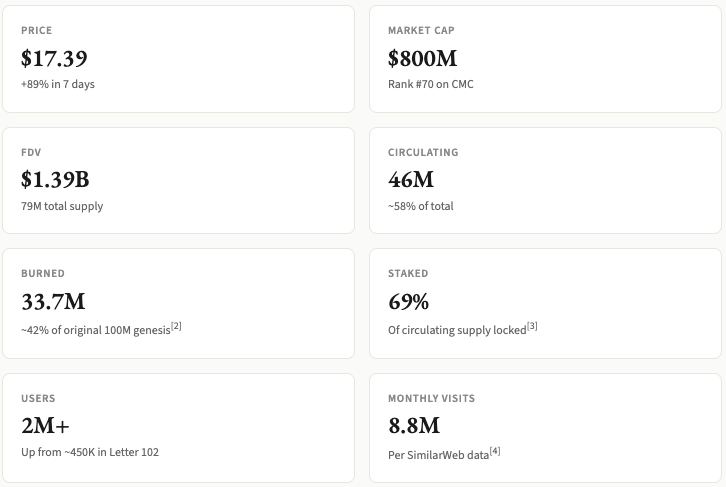
I wrote a deep dive on Venice back in early March (Letter 102). VVV was sitting around $6.50, the market cap was roughly $294M, and I laid out why I was bullish: real product, real users, token directly tied to platform usage, and a tokenomics system that just made sense.
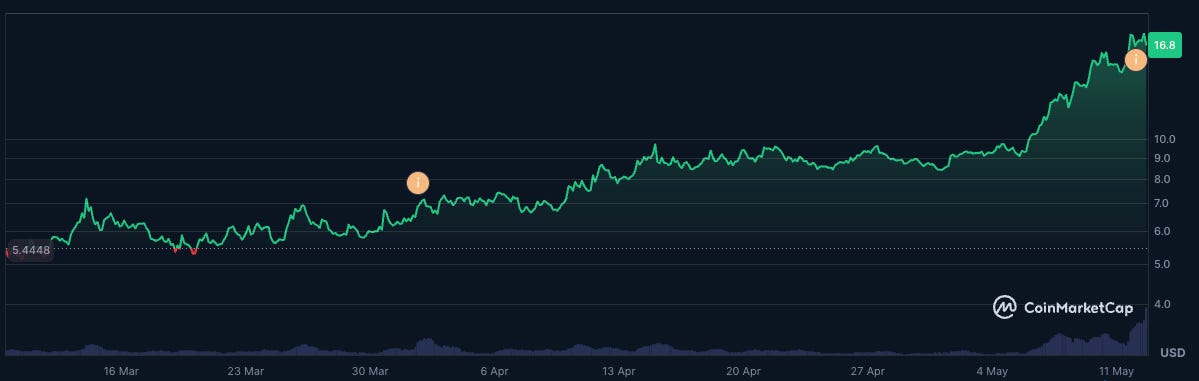
That was 70 days ago. Since then, the ecosystem has soared with both VVV and DIEM hitting new highs after new highs.
So today I’m doing an update on what’s changed, what’s driven the move, and where I think things go from here.
If you’re interested in leveling up your AI learning journey even more, then check out the new company I have launched alongside a couple of friends: The Stoa of AI.
We create video courses and have weekly live workshops and calls that show you practical ways to implement AI into your daily workflows.
We’re in early access mode with discounted pricing, check us out here: https://www.skool.com/thestoaofai
A quick look at the numbers
Things have boomed across the board, so here’s a quick snapshot of where some of the key numbers are standing today:
What’s happened over the last two months?
There are five key things that happened between Letter 102 and now:
Verifiable end-to-end encryption (March 18)
This was a technical milestone that a lot of people had been waiting for. One of the main criticisms of Venice up until this point was that their privacy was on a “trust me bro” basis. On March 18, Venice shipped four privacy modes, the most important being Trusted Execution Environment (TEE) and full End-to-End Encryption (E2EE), through partners at NEAR AI Cloud and the Phala Network.
This made things shift from “trust us, we don’t log your prompts” to “you can cryptographically verify that we cannot see your prompts.” Each response includes attestation evidence you can independently verify. It’s a real, hardware level guarantee.
For regulated industries, this is a big deal. A US federal court recently ruled that using standard AI tools could waive attorney-client privilege precisely because they lack confidentiality guarantees. If you’re a law firm, hospital, or financial institution, you literally cannot use ChatGPT for client work in a defensible way.
While most will probably still choose to host their own local LLMs, Venice at least gives anyone with confidentiality concerns an alternative option and way to use models without leaking private information to Big AI.
VVV jumped about 10% the day of the announcement and that was the start of the real run.
Programmatic buy and burn launched (April 15)
Up until April 15, Venice’s buybacks were discretionary. The team would use a portion of monthly revenue to buy and burn VVV on the open market, but the timing was at their discretion.
On April 15, they switched to a programmatic engine: every new Pro subscription triggers an automatic, on-chain $1 market buy of VVV that gets immediately burned. The buybacks became verifiable, predictable, and directly tied to revenue.
Burn sizes increased (April 27)
There was some criticism around that first announcement that the buyback amounts “weren’t enough”, and so twelve days later, they cranked the burns up, with a new tiered structure based on the level of subscription someone signs up for:
Pro subscription: $2 in VVV burned (up from $1)
Pro+ subscription: $5 in VVV burned
Max subscription: $10 in VVV burned
The market, unsurprisingly, liked this decision too.
Staged emission reduction (effective May 1st)
The Venice team committed to reducing the VVV emissions by 50%. From their X post:
May 1: 6M → 5M annual emissions
June 1: 5M → 4M
July 1: 4M → 3M
For context, emissions started at 10M/year at launch. By July 1 they’ll be at 3M/year. A 70% cut from the original rate in under 18 months.
Combined with the programmatic buy and burn, this is the path to VVV becoming net deflationary. They’re still a long way off this becoming a reality but with emissions reducing and buybacks increasing and overall adoption and usage of the platform skyrocketing, everything is moving in the right direction.
StrikeRobot partnership (May 7-11)
This one is really cool. As you know, I am bullish on Robotics too (both in general and onchain robotics), having written about the sector earlier this year.
Venice is now powering humanoid robots with private AI vision and decision making, through a partnership with StrikeRobot because, quote, “Your AI shouldn’t spy on you.”
I bring this up not because robots are necessarily going to move the needle on revenue this year, but because of what it signals. Venice is being chosen for high stakes physical applications where privacy actually matters. A robot in your home, watching you, making decisions about you. Do you really want OpenAI, Google, or Anthropic to have access to that data?
A deeper look at DIEM
I covered the basics of DIEM in Letter 102, but it deserves a much bigger spotlight here because I think it’s still one of the most underappreciated parts of the Venice ecosystem. Most VVV analysis I read fixates on the buy and burn, which is of course important, but DIEM is the part that really excites me (partly because I am actively using it myself on a daily basis).
So let me actually explain what DIEM does and why it matters.
A quick refresher
Each DIEM token equals $1 per day of Venice API credit, forever. If you hold 100 DIEM, you have $100/day of Venice inference, every day, indefinitely.
DIEM can only be minted by locking staked VVV (sVVV). The mint rate is dynamic and rises as DIEM supply approaches Venice’s target. While your VVV is locked, you continue to earn 80% of normal staking yield. To unlock your VVV, you burn the equivalent amount of DIEM.
So the cycle is:
VVV staked → VVV locked → DIEM minted → DIEM burned → VVV unlocked.
Why this is structurally clever
DIEM creates a futures market for AI compute.
If you’re a developer or AI agent using the Venice API daily, it can be hard to budget because regular API pricing fluctuates and costs are unpredictable.
DIEM solves this by letting you buy your compute upfront. 100 DIEM costs you whatever the market price is today. From that day forward, you get $100/day of inference with no future bills or costs. It’s a fixed-cost compute futures contract.
Not to mention the potential benefit of being able to sell your DIEM at any point too, meaning if you sell in 2 years at the price you got it for, your compute was essentially free.
The DIEM market right now
What I’m watching is the ratio of DIEM market price to its underlying fair value. Each DIEM produces $1/day of compute, so over 365 days that’s $365 of value (less if you discount for time, more if you assume AI compute costs rise over time). If DIEM trades at $200, payback is around 200 days. If it trades at $1,500, the payback period is over four years. The market is essentially pricing in expectations about how much Venice API access will be worth in the future, and that’s a real economic signal.
How DIEM creates VVV demand
Every time someone mints DIEM, they have to lock VVV. That VVV is taken out of the circulating, sellable supply. It’s effectively a second supply sink on top of the buy and burn.
Think of it this way. If you’re an enterprise developer who needs predictable AI compute costs, you have two paths to access Venice:
Path A: Subscribe to Pro/Pro+/Max and pay Venice in fiat. Venice uses that revenue to buy and burn VVV.
Path B: Buy DIEM on the open market and stake it for daily credits. The DIEM you bought required someone to lock VVV to mint it.
Both paths create VVV demand. Path A through direct burn pressure. Path B through removing tradeable VVV from supply. As Venice’s user base scales, both paths grow simultaneously.
Some valid criticism to the model, and some counterpoints to it
There’s been ongoing pushback on the DIEM model with the main argument from skeptics being that when developers buy DIEM and use it for compute, no new cash hits Venice’s balance sheet (unlike Pro subscriptions which do generate cash revenue). The concern is that DIEM could cannibalize Pro subscriptions and drain future cash flow.
Venice founder Erik Voorhees has pushed back on this directly by saying that DIEM was designed to solve pricing instability and create programmable compute, not to be a primary revenue mechanism. The Pro subscription model funds Venice as a company and DIEM creates a secondary economic layer.
I think one important thing to keep in mind is that DIEM holders aren’t necessarily the same population as Pro subscribers. Pro subscribers are mostly individuals and small teams who want a chat interface and convenience, and often are not crypto native at all.
DIEM holders are developers, AI agents, and enterprises that are crypto native and that want guaranteed, programmable access for production workloads. They’re different markets, and Venice serving both expands the total addressable market rather than cannibalizing one with the other.
Where I think things go from here
Here’s how I’m actually thinking about my holdings and positions in both VVV and DIEM personally.
The fundamental thesis has gotten objectively better since Letter 102 with programmatic burns, faster emission cuts, a real enterprise privacy product, and 4x user growth. Every dial moved in the right direction.
I was bullish then, and I am obviously still bullish now, from a fundamentals and company / ecosystem perspective.
From a price perspective? I am taking some profits off the table. I think we’re at the point where the market is frothy for all things Venice, and while there’s always still room to run, we’re at that point where the Banklesses and Ansems of the world are talking about the fascinating tokenomics of DIEM.
If this was 5 years ago, when Bankless and Ansem started talking about something, it was considered early. Today? It’s more likely to be a local top than to be early.
In other words, I’m not frothing at the mouth to buy VVV at $18 or DIEM at $1500. I’ll gladly take a few chips off the table here, and if we get a significant dip (40-50% or so) then I would be looking to add more to my stack.
I’ve got a bag of both that I am holding longterm — especially my DIEM which I am using daily to power my Hermes agent(s). But in this market and climate, I think it would be silly to not be thinking of taking profits too.
The whole point of having a thesis is to act on it before everyone else does. If you missed the entry, you missed the entry. The market gives you opportunities every cycle. The next opportunity is always coming.
Final thoughts
I think Venice is one of a very small number of AI x crypto projects where the fundamentals genuinely justify a real position over a multi year timeframe.
That doesn’t mean it goes straight up from here, it won’t. It doesn’t even mean it’ll be up from here in a few years. Nobody has any idea what is going to happen on a multi year timeframe in this space, and anyone telling you otherwise is lying.
The best thing to do, in my experience, is find good projects, with good fundamentals, at good prices, and buy sensibly, and take profits sensibly. Much easier said than done, but if you’re thinking about positioning in the AI x crypto space, this remains one of the best projects out there. Just perhaps not right this minute at these all-time-high-ey prices.
I’ll write another update in a few months (either as a standalone or as part of a portfolio review).
In the meantime, I’d love to hear what you think. Reply directly or leave a comment below.
Thanks as always for reading!
Disclaimer: The content covered in this newsletter is not to be considered as investment advice. I’m not a financial adviser. These are only my own opinions and ideas. You should always consult with a professional/licensed financial adviser before trading or investing in any cryptocurrency related product. Some of the links shared may be referral links.
Didn’t they do an airdrop a few years back?
http://Venice.AI is really interesting but $NEAR also. Fich strategy continues to hold NEAR due to its strong momentum: https://research.fich.ai/p/privacy-and-infrastructure-on-focus