

Welcome to Little Learnings, a series of educational posts I release every Friday where I pick a topic and break it down as simply as I can.
This post is sponsored by Magic Eden
Magic Eden made a major announcement today, sharing their plans to shift their focus on DiceyHQ, their product in the crypto casino & sportsbetting space.
Unfortunately this means they are sunsetting some existing products: their EVM marketplace, Bitcoin marketplace, Bitcoin API, and Magic Eden Wallet are all being wound down over the next few months.
I genuinely think this is a smart move for them as a business. If I were advising them, and had access to their internal metrics, I would probably suggest the same thing. It makes me a little sad that so much of our space is headed towards becoming trading / gambling / prediction market apps, but it is the reality of the world. Better they pivot to something that can make them revenue than shut down entirely.
Read more here: https://x.com/0xLeoInRio/status/2027427791533146367
What Are AI Agents, Actually?
I’ve been messing around with AI agents for the last month or so. Like, properly - giving openclaw full access to a computer (yes I bought into the mac mini craze) and getting it to go do things while I do something else.
Most people’s mental model of AI is still “a thing I type questions into.” That made sense a year or two ago. But it doesn’t capture what’s happening now, so I thought I would try to explain what agents are and how they work.
The simplest way I can explain an AI agent: it’s AI that does things, not just says things.
When you use ChatGPT or Claude or whatever, you’re having a conversation. You ask, it answers. Even when it generates an image or analyzes a file, it’s the direct result of a direct request or prompt that you make.
An agent is different. Basically, you give it an end goal and it figures out the steps. It can browse websites, write code, create files, send messages, call APIs, and chain all of that together without you telling it how or needing to stop and ask you for directions (or permission) at every step of the way. You just come back later and the work is done… it feels like pure magic a lot of the times.
This gap between “AI that talks to you” and “AI that works for you” is enormous. It’s kinda like the difference between googling a recipe and having someone cook dinner (we’re not here yet.. but add some robotics to agentic AI, and boy oh boy, are things gonna get wild).
The reason this explosive agentic movement is happening now and not two years ago comes down to reliability. The models used to fall apart on anything with more than a few steps. They’d lose context, make weird mistakes, massively hallucinate, or just stop halfway through. The latest models from Anthropic, OpenAI, and others have crossed a threshold where they can reliably handle complex, multi-step work. Not perfectly, but well enough to be genuinely useful.
There’s also a new standard called MCP that’s quietly becoming a big deal. It stands for Model Context Protocol and the easiest way to think about it is as USB for AI. Before USB, every device needed its own special cable and driver to work. MCP does the same thing for AI tools. It gives agents a universal way to plug into anything. Your calendar, your codebase, your database, your email, whatever.
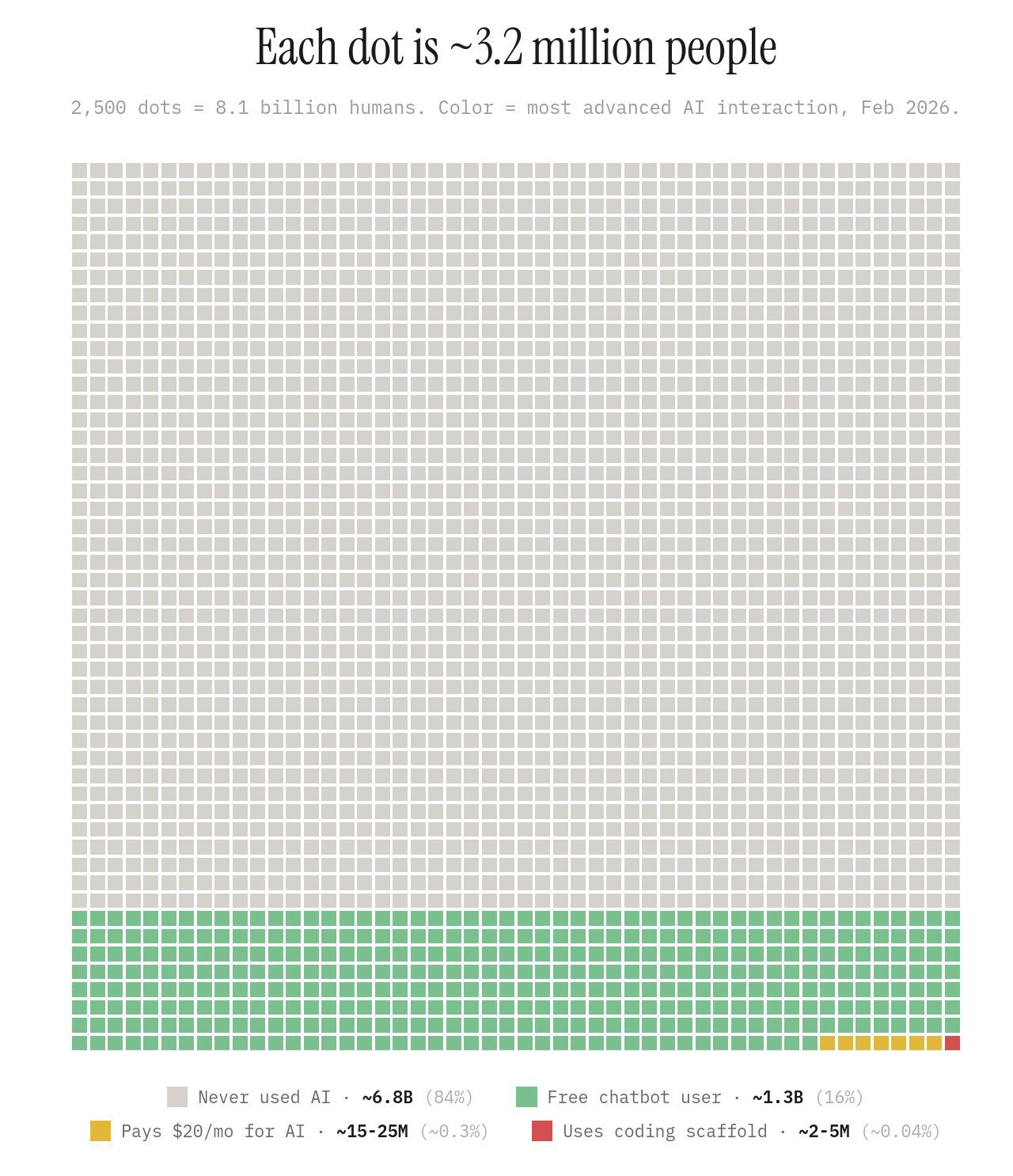
And we’re still early. Really early. Agents work, and they work well enough to be useful right now. But the tooling is rough, the setup isn’t trivial, and most people that are using agents still haven’t figured out how to integrate this into their daily workflow yet.
This chart shows just how early we are in the grand scheme of AI:
I think within one to two years, most knowledge workers (that still have jobs) will have some kind of AI agent running in the background handling parts of their work. The people experimenting now are going to have a meaningful head start. Not because agents are hard to use, but because learning to work effectively with an autonomous AI takes time. You have to build trust in what it can handle and develop a sense for what it can’t.
In four to five years, god only knows where things will be.
I think everyone curious about this kind of thing should at least experiment and give it a go yourself. Start small, and pick a task you spend 30 minutes on regularly and see if an AI can do it. You’ll learn more from trying to do this than from reading a hundred articles about it.
If there’s interest, I can make a follow up post with a step-by-step guide on using an AI agent.
For now, thanks for reading, see you next week with another little learning!
Disclaimer: The content covered in this newsletter is not to be considered as investment advice. I’m not a financial adviser. These are only my own opinions and ideas. You should always consult with a professional/licensed financial adviser before trading or investing in any cryptocurrency related product. Some of the links shared may be referral links.
i still don’t fully understand the security risks involved (seems like no one says much about it). like this could be useful for doing things on my cloud services, but do i want to give it access to that? i would like to get going with this, though. also why is mac mini the choice?
Enjoyed the read. I would like a step-by-step guide and also more newsletters about AI in general. Cheers