

I’ve spent the last two weeks absolutely neck deep in Claude Code and the world of AI. I was in a similar spot towards the beginning of this year and then got burned out and took several months away from screens and agents. Now that I am well back into the thick of things, it is absolutely mind blowing just how much more powerful AI has become.
I have always had the most insane expectations for AI, and it is still exceeding them on a daily basis.
All of this to say, when it came to working on my portfolio update, naturally I had to enlist Claude in the process.
Today’s Letter is sharing my portfolio structure and plan, which includes solving one of my greatest problems: how to deal with opportunity cost and wanting to be in a lot of trades while not also succumbing to portfolio fatigue and death by a thousand cuts.
There are so many tokens out there that you just know will pump eventually off some catalyst or season or meta. PNKSTR is one, it’ll have its moment the next time NFTs are back in fashion. RHEA is another. It was such an easy and obvious play that it would pump once NEAR started rallying. My problem is I’ve never really been able to have the systems and discipline to stay on top of all these trades. Buying at the right time, remembering to sell, keeping umpteen positions in my head or in a janky spreadsheet.. the mental overhead and fatigue is real, as readers of this newsletter will well know.
So I sat down with a LOT of help from AI and built myself a system. In this Letter we’ll cover:
Separating my portfolio into buckets
The core
Swing trades
Cash, trading, and NFTs
How AI helped build it, and how it’s gonna help me stick to it
Let’s jump right in.
The Buckets
Everything I own now lives in one of six buckets. Each has a target size and its own rules. If something doesn’t fit a bucket, it gets sold.
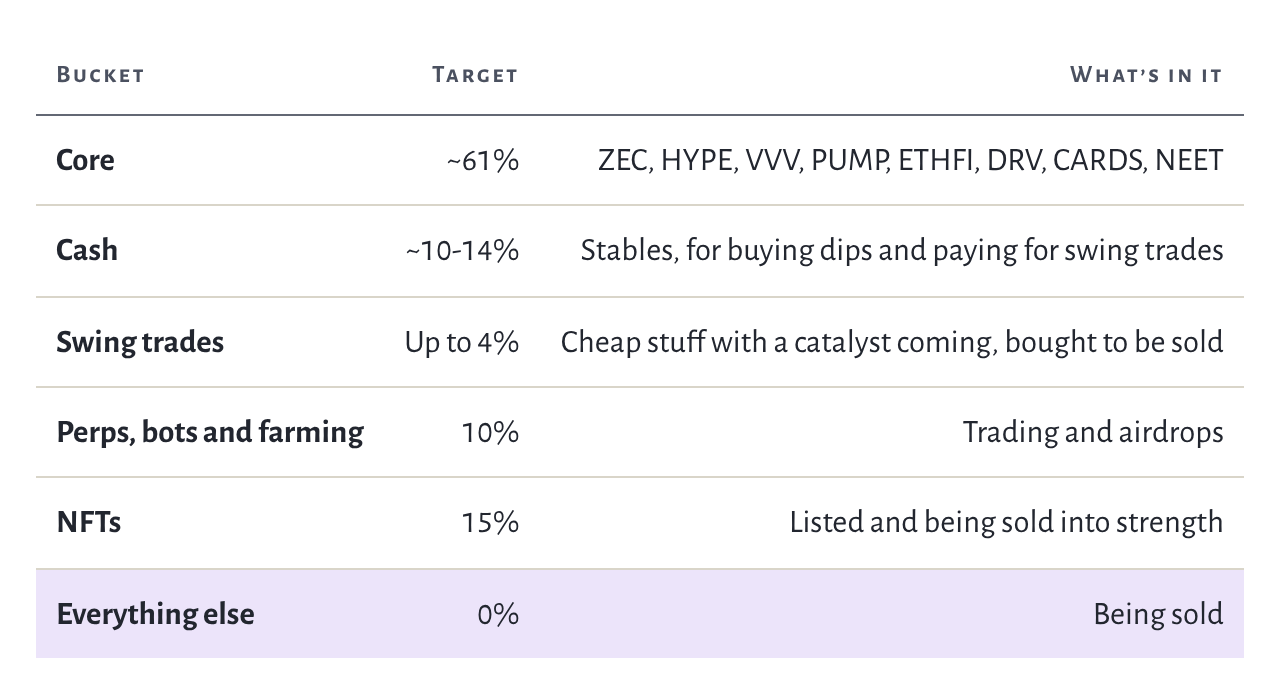
Fairly self explanatory. These are target position sizes — I am not there yet. It still requires a bit of selling off things and consolidation, but I expect to be there soon.
The Core
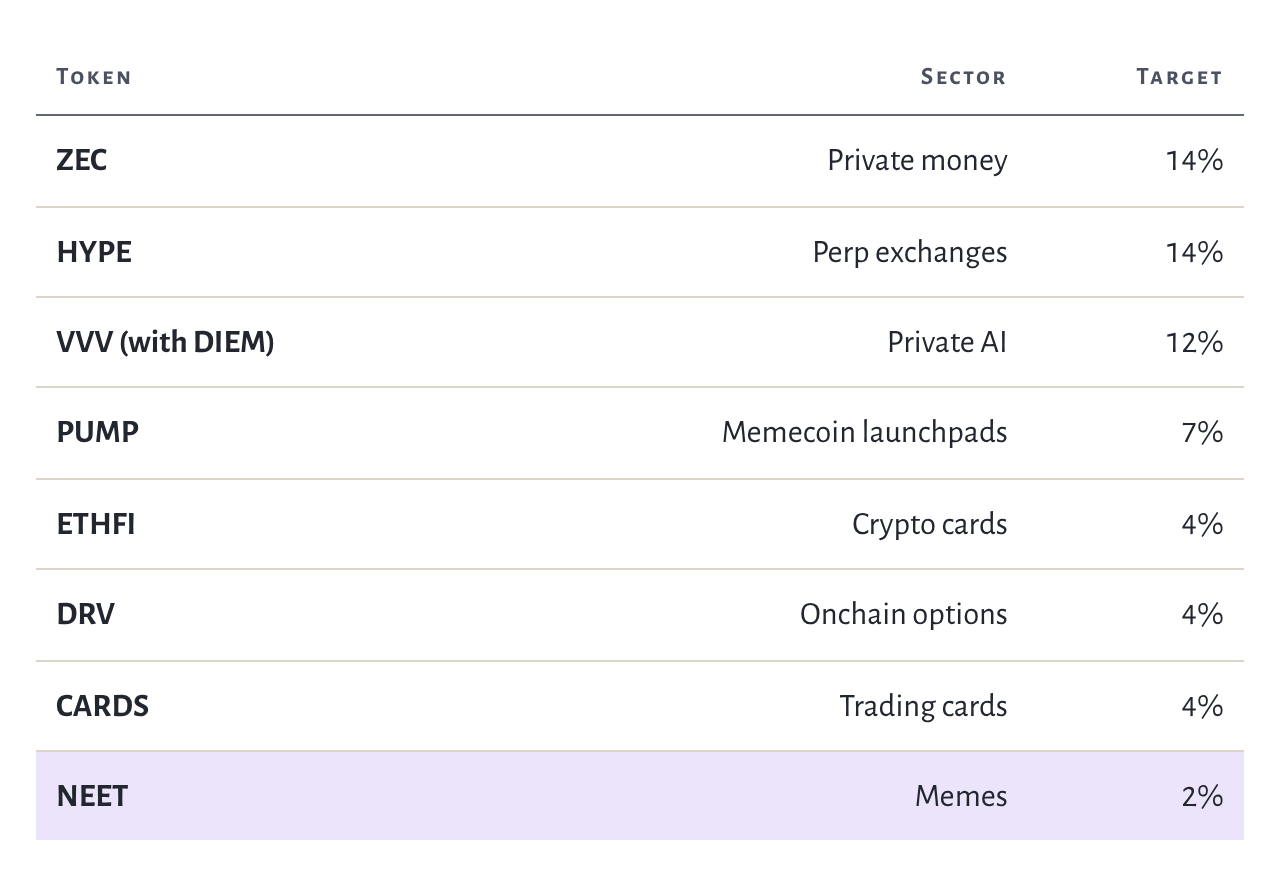
The gist of my core portfolio is to pick my highest conviction play in a sector and hold only that. No beta tokens. Most of these holdings also follow along from last week’s newsletter in terms of being value investments. Businesses that generate real revenue and use that revenue to support the token price.
A couple of obvious exceptions. ZEC is a store of value play and one of my highest conviction bets for the cycle. NEET is a pure meme play and as such only makes up 2%, and it’s probably the only remaining meme coin I have any level of conviction in. Obviously the highest risk token in my portfolio now.
Some core rules for the core holdings:
No token above 15% on purpose, if price moves it above 20% I trim
New money goes to whatever’s furthest below its target
Every token has a research dossier and once a week an AI agent will research announcements and onchain metrics and look for anything noteworthy — and alert me if there is something I should be aware of
Swing Trades
This is my answer to all those “eventually” tokens from the start.
A swing trade is something I buy because it looks cheap and there’s a catalyst coming up, or there’s momentum that should push it higher in the short-medium term. The whole point is that I have to actually take profits when the thing happens instead of trying to turn a swing trade into a core position and then roundtripping.
The rules:
Up to 4% of the portfolio in total, and 1.5% max per trade when I buy
Spot only, no leverage (that’s what the perps bucket is for)
Paid for out of cash, and the profits go back to cash
Before I buy, I write down why it’s cheap, what the catalyst is (with a date if there is one), where I’m taking profit, what would make me wrong, and when I give up on it
A swing trade can graduate to core, but only if the evidence is overwhelming. Not because it’s down and I don’t want to sell it. That’s how swing trades turn into overweight bags.
The first three are TAO, BAT, and ENA which I already hold:
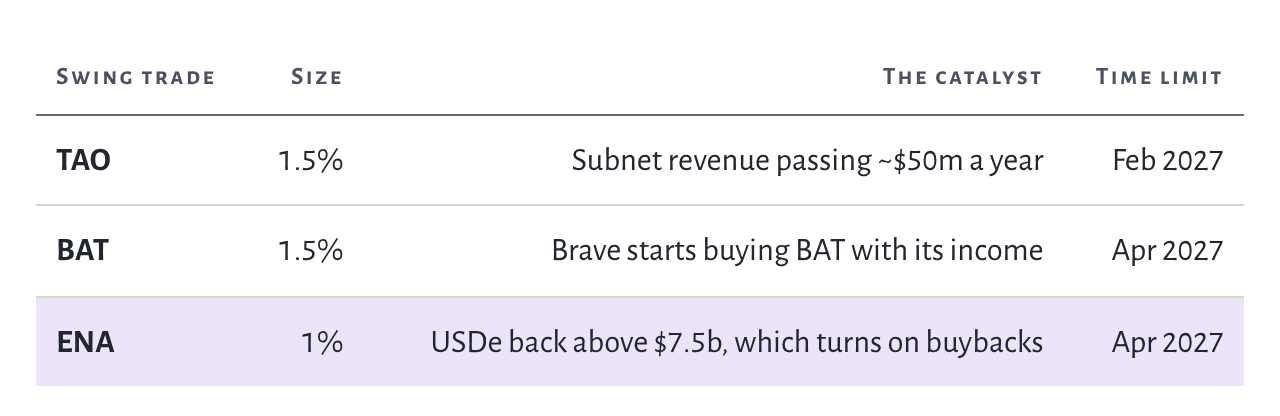
TAO sure stings a bit. I still think it’s the closest thing to an index on decentralised AI, but it hands out ~11% of its supply every year in new tokens against maybe $30m a year of real revenue, and more TAO has left the subnets than gone in every month since February. So it’s not a comfy eyes-shut long-term hold for me any more and I am reducing my position size. The catalyst I’m watching is revenue. The best estimate I’ve found (SubConnect’s revenue index, in August) put subnet revenue at about $28-35m a year, and they’re projecting over $100m by the end of 2026. If their next update shows it clearing ~$50m, that’s real progress
BAT feels pretty great to me. Brave’s Roadmap 4.0 says some of its income will go into buying BAT for user rewards, but there’s no number on it and no buying yet, so it feels like a good token to buy and sell whenever there’s news/speculation around that. I could see this being a good token to swing trade a bunch of times over the next six months, and if the buyback details are promising there’s a chance it turns into a core position.
It’s never been easy to get good stablecoin exposure via a crypto token, so ENA has always been interesting to me for that reason, especially since USDe has now well and truly survived a bear market. ENA’s catalyst is its fee switch. It passed a vote in September to turn it on once USDe’s two-week average gets above $7.5b, and it’s about $4.6b right now.
Everything else from my old list of small bets is gone (or rather going, going… gone).
Cash, Trading and NFTs
Cash
About 14% long term, and swing trades get paid for out of that, so cash itself should sit somewhere between 10% and 14%. If and when my cash reserves go above 14% because of profitable trades, the excess goes into building up my core positions even more. As we get deeper into the bull market, I will want to increase my cash holdings.
Perps, bots and farming
Basically a separate cash bucket that is being used to farm protocols, experiment with bots, and play around with perps. PaperTrade, Variational, etc. I think of this a little bit like my experimental play money. I am obviously wanting and trying to make profit with all of this, and I think I should be able to, but it’s a chunk of money I can do stuff with every single day and not be chopping up my spot positions by overtrading myself to death.
NFTs
I need to sell off a little bit here to get down to my target of 15%, which is in and of itself a much higher allocation to NFTs than most people have. What else is there to say here other than, I still very much do love the jpegs.
How AI Helped (And Will Keep Helping)
Pretty much everything in this Letter came out of a long back and forth with Claude, and it helped in two very different ways.
Building the plan
I basically spent 10-15 hours over the last couple of weeks asking for various types of research to be done, sharing my thoughts on the market, telling Claude how I felt strongly about tokens with buybacks, and how I was overwhelmed at times with too many tokens, but how I also felt like I was leaving money on the table by not trading certain spots.
I asked for help coming up with a plan that was easy to work with, and for help implementing it and staying on top of it.
Implementing the plan
This is the part I’m most excited about, and there are three layers to it.
The first is my portfolio dashboard. Every morning at 4am local time a job reads my wallets straight from the chain, prices everything and saves a snapshot, so I can see where each bucket sits against its target. Every Sunday it goes through my NFTs one by one and values each at its best bid on OpenSea. It has a trim and a stop price for each token, it watches all my perps positions and any liquidity pools I might have open, and checks for any airdrops I might be able to claim.
The second layer is the research side. Every Monday morning another job goes through the tokens I’ve written theses on (which covers all of the core and all three swing trades) and checks for anything that changes the story: unlocks that got moved or added, buybacks that sped up or stopped, big wallets sending tokens to exchanges, ETF filings. Everything it finds gets a dated note and a source, and I get a short summary on my phone. It’s already caught stuff I would have totally missed and I have no doubt it will continue to do so. It’s also a system that will be constantly improved and will hopefully be able to provide faster and better signals as time goes on.
Any time I want more research on a token, I just message Claude and ask it to research X and it gets added to a watchlist. I can say things like “I think RHEA is a good token to keep an eye on, if NEAR starts running, it could be a good idea to pick up a small position here since RHEA usually pumps not long after”, and then I will get notified if and when that happens. That is the third and final layer.
The third layer helps ensure I don’t miss anything, even if I get lazy and neglect to be proactive. Basically there’s a “watcher” bot/agent that checks my dashboard and research each day and pings me when something important happens. I use an app called Nfty that allows for it to send push notifications directly to my phone. Pretty sweet, def recommend if you don’t want to miss things and also don’t want to be refreshing apps 100 times a day.
Final Thoughts
I have basically never felt better about my portfolio. Both in terms of the makeup of it, and the management of it. While it’s not yet fully in its final form, the pathway to final form is there and it is crystal clear.
I strongly strongly strongly recommend everyone take some time to chat with AI about their investment strategy, plans, goals, etc. And more than that, sit down with an agent that can code and get it to build cool shit for you. Dashboards, research dossiers, watchlists and watchers, it really can do it all.
Get AI to find all the onchain metrics you’ve always wondered about but never knew how to find. Get AI to find new airdrops to farm. Get AI to find new tokens and hidden gems.
It’s never been a more exciting time to be alive and to be a curious minded person who wants to do things, because, for the first time ever, we are basically only limited by our imaginations.
Disclaimer: The content covered in this newsletter is not to be considered as investment advice. I’m not a financial adviser. These are only my own opinions and ideas. You should always consult with a professional/licensed financial adviser before trading or investing in any cryptocurrency related product.
just started on claude bro thank you for the knowledge