

Hey all. I’m back. Thanks for the patience while I took some much needed time away from screens and the digital world. I’m looking forward to writing again and sharing my thoughts and theses with all of you, so let’s get cracking.
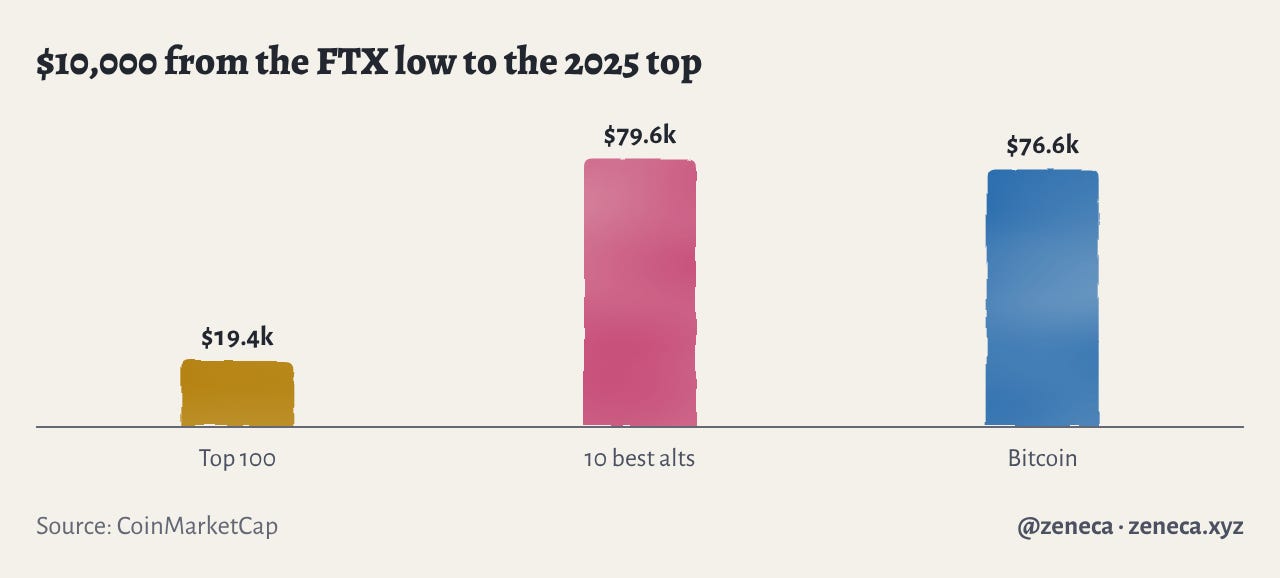
Let’s say you had $10,000 on the 20th of November 2022, roughly a week after FTX blew up, which is about as close to the bottom as any of us are ever gonna get. You put $100 into each of the 100 biggest coins and held every single one of them through the whole bull market, the ETFs and the election and the inauguration pump and all of it, right up to the day the total market peaked on the 6th of October 2025. How do you think you’d have done?
You’d have roughly doubled your money, to about $19,400. Which is not bad, except when you look at the alternative. Had you simply put the same $10,000 in just Bitcoin and walked away, it would have been worth about $76,600. Three quarters of the gains from the top 100 came from just ten coins, while the median coin in the basket was worth 99 cents for every dollar you’d put in. So even going from the bottom of the bear to the pico top, more than half of your coins were down.
It is not easy to outperform Bitcoin.
That’s the spray and pray approach, the way a lot of us learned to play crypto, and for a long time it worked really well. It has clearly stopped working. It didn’t work last cycle, and it certainly won’t work this cycle. I think what’s replacing it looks much more like value investing, something more Ben Graham and Warren Buffett than anything we’ve seen in crypto before.
So this letter is about that shift, and about how I’m planning to play the next bull market because of it.
The TLDR:
Spray and pray used to be +EV, and every cycle since 2017 it’s paid less than the one before.
Chasing metas has the same problem. The winners of each one mostly never come back, and tens of thousands of new tokens launch every day fighting over the same money.
Meanwhile the money projects spend buying back and burning their own tokens has grown about tenfold since 2021, and it held up through a bear market. Over the year to October 2026, tokens with real buybacks beat Bitcoin about twice as often as everything else.
So I want to do what Graham and Buffett did with stocks, which is own a handful of good businesses that put real money into their tokens, buy them when they’re cheap (or when the growth isn’t priced in yet) and hold them for years.
What happens to the bought-back tokens matters too. A burned token is gone for good, while one handed out as a reward usually gets sold straight back into the market.
ZEC is my exception, a store of value with no buybacks at all (Buffett would hate it, but he hates Bitcoin and gold too, so whatever).
How did we get here?
Those of us who were around in 2017 will remember that pretty much everything went up. The median top-100 coin did something like 46x into the January 2018 peak and most of them beat Bitcoin, so if you bought a basket of whatever was on CoinMarketCap you were gonna do great almost no matter what you picked. That’s where spray and pray comes from, and honestly, in that market it was probably the right play.
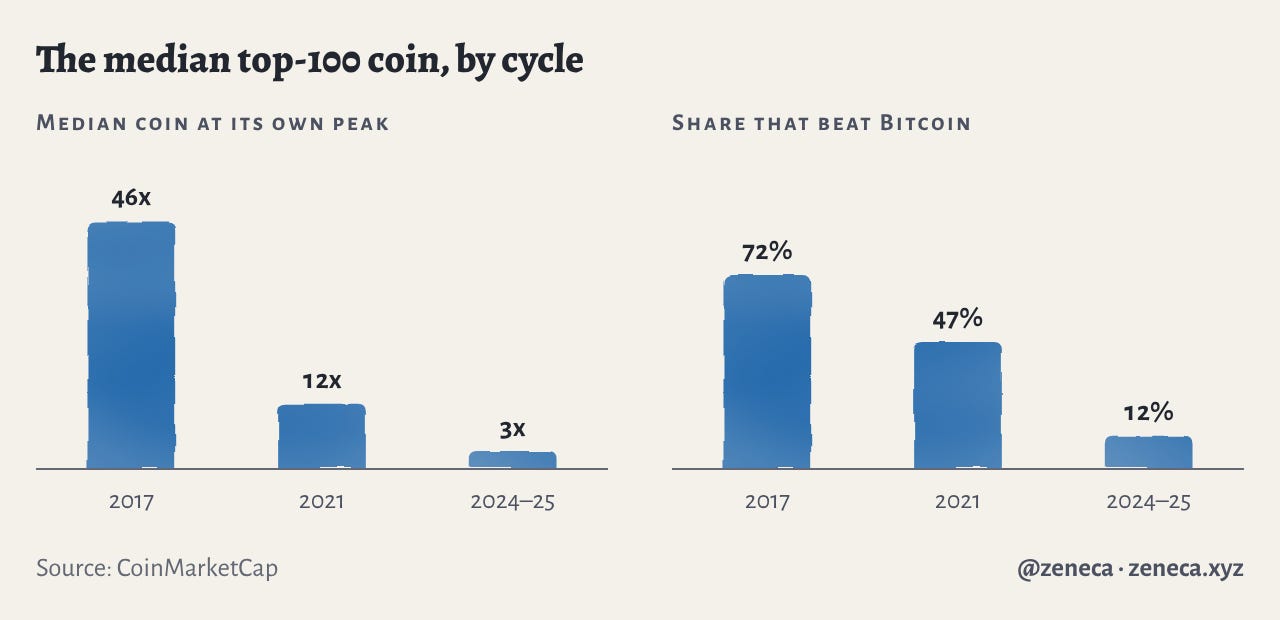
2021 was still broad, just smaller, and the median coin did roughly what Bitcoin did. Then in 2024–25 the median top-100 coin only tripled even at its own best moment, only about one in eight beat Bitcoin, and most of them had already topped by mid-2024, more than a year before the market did. If it felt to you like your alts topped in early 2024 while everyone kept telling you it was still a bull market, that’s because most of them did, and most people probably would have frustratingly roundtripped their alt bags waiting for the elusive “alt-szn” which never came, and will probably never come again.
The other way plenty of us played it was chasing metas. ICOs, DeFi summer, NFTs, alt L1s, memecoins, AI agents, and I’m sure I’m forgetting some. Get into the new thing early and out before everyone else, which works great right up until it doesn’t. Only about one in ten of the 2017 top 100 ever made a new high in the following cycle, and memecoins as a whole are worth about a fifth of what they were at the December 2024 peak. And don’t even get me started on NFTs (🥲).
Here’s something interesting though. Certain alts seem to be decoupling from Bitcoin, even in bear markets.
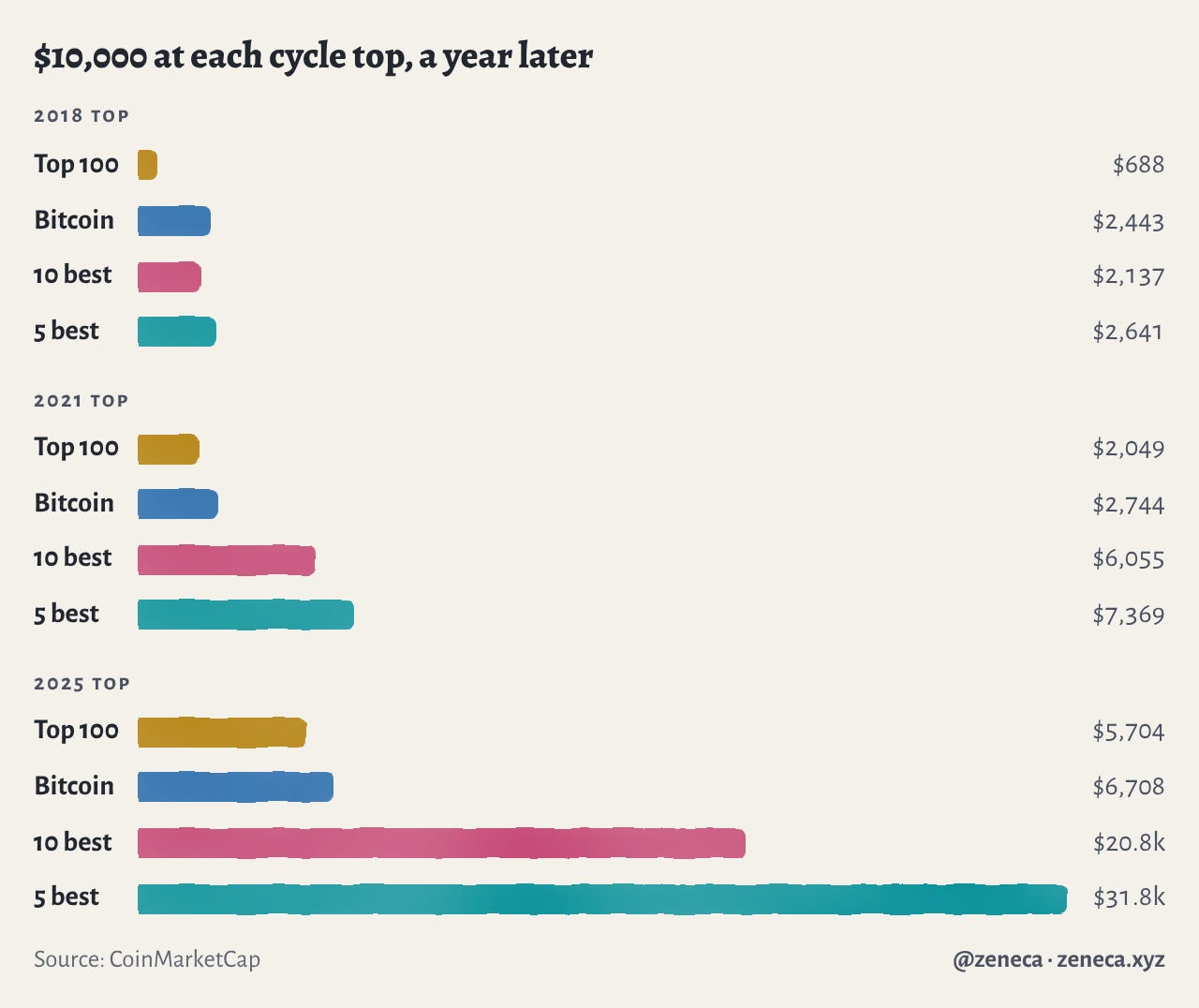
Say you took $10,000 at the last cycle top, on the 6th of October 2025 and, spread it across the 100 biggest coins. That would be worth about $5,700 today (only six of the 100 were up at all), vs about $6,700 if you’d put it all in Bitcoin. But if you’d somehow known which coins would hold up best and put $1,000 into each of the ten best, you’d have had about $20,800, and $2,000 put into each of the five best would have got you about $31,800.
I ran the same thing from the last two cycle tops as well to compare, buying on the 7th of January 2018 and the 8th of November 2021 and holding for a year. This shows a clear trend: the best coins are decoupling from BTC.
So how do we find and pick the “best” coins without the benefit of hindsight? For that I think we need to look at why spray and pray stopped working in the first place, and where capital is flowing to instead.
Why did spray and pray stop working?
Mostly, I think, b/c there are way too many tokens chasing the same money. This shouldn’t be anything mind-shattering to readers of this newsletter. It’s been clear for years that there are way too many tokens
At the January 2018 peak CoinMarketCap listed a bit under 1,400 coins in total. At the end of August 2026, Pump.fun alone was launching around 44,000 new tokens a day. The number of tokens went up by a few orders of magnitude, and the number of buyers (and amount of capital) obviously didn’t keep up.
The big money that did come in mostly went to the biggest names. Bitcoin took about two thirds of everything the market added between the FTX low and the October 2025 peak, ETH, XRP, BNB and SOL took about a quarter, and every other coin put together got about a tenth. ETFs, treasury companies and funds don’t spray and pray. They buy a few things they can explain to their own investors and sit on them.
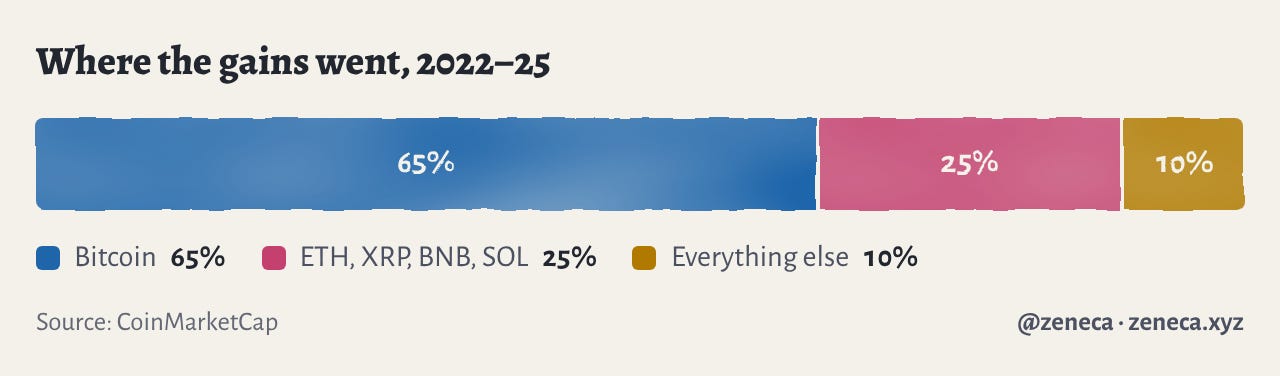
Even that last tenth went to very few coins. Ten of them took almost half of it, mostly old names like DOGE, TRX, ADA, LINK and XLM, with HYPE and SUI the only newcomers. Over the same stretch the number of coins listed on CoinMarketCap went from about 21,800 to about 36,200, and Pump.fun alone launched millions more, so the vast majority of new coins got basically nothing.
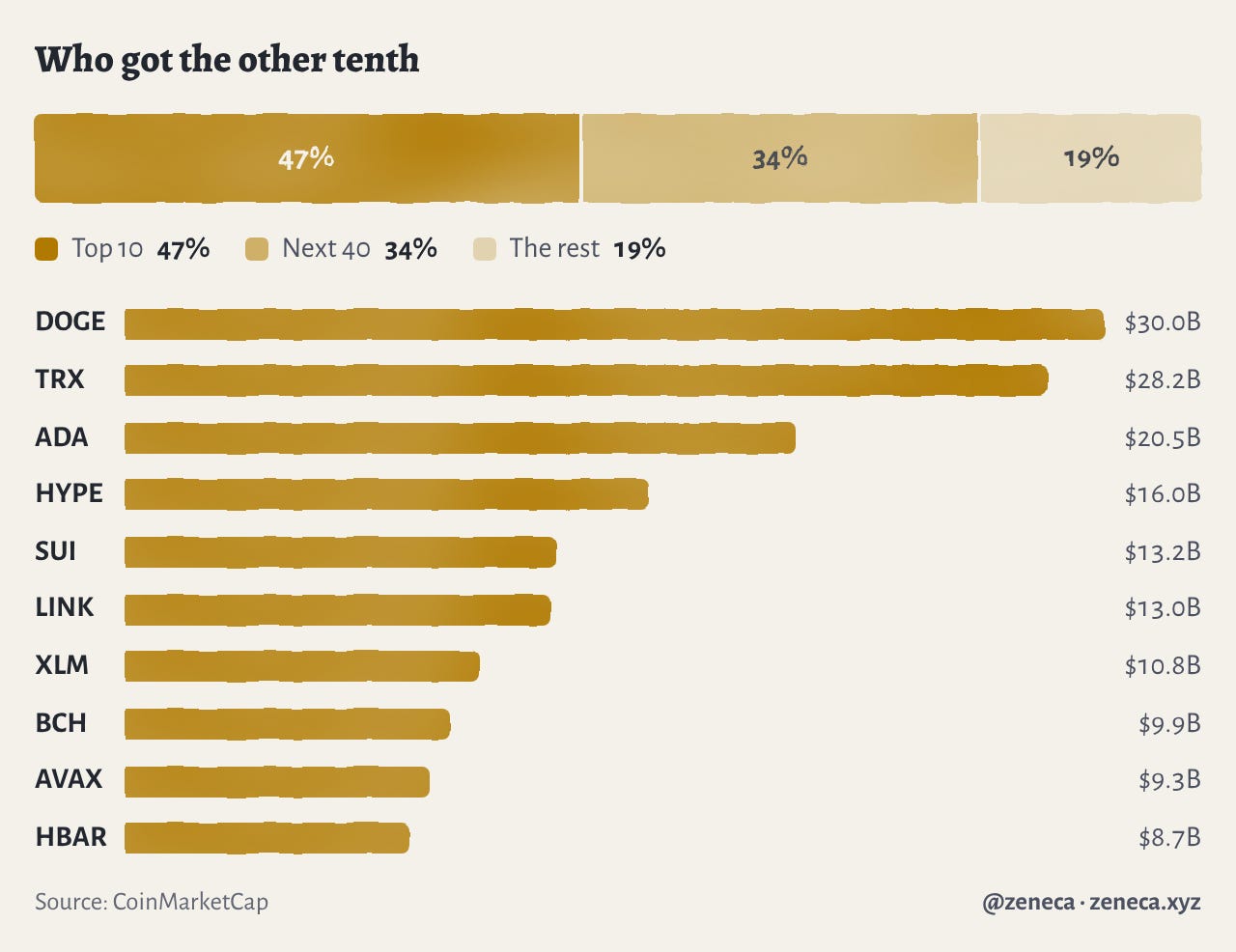
So if the next run looks anything like the last one, owning too many coins is mostly a way of making sure you own a lot of the ones that go nowhere.
What’s replacing spray and pray?
Something many of us have long hoped for in the pursuit of the great crypto dream is to have crypto-native projects that spend real money on their own tokens. Mostly that means buybacks and burns, which take tokens off the market (a few, like Aerodrome, send fees to people who lock the token up instead).
We’ve always had some of these tokens around, but we’re seeing a lot more of them now, and the market is responding to them with strength and love and a flood of capital. It turns out, we like when the tokens we hold belong to protocols that generate real revenue, and we LOVE when they use some of that revenue to support their token price and their holders.
Token buybacks went from about $190 million in the year to October 2021 to about $1.85 billion in the year to October 2026, while the number of projects spending $1 million or more a year went from 10 to more than 70. DefiLlama keeps adding protocols as it goes, so some of that is just better coverage, but even so it’s a pretty big change.
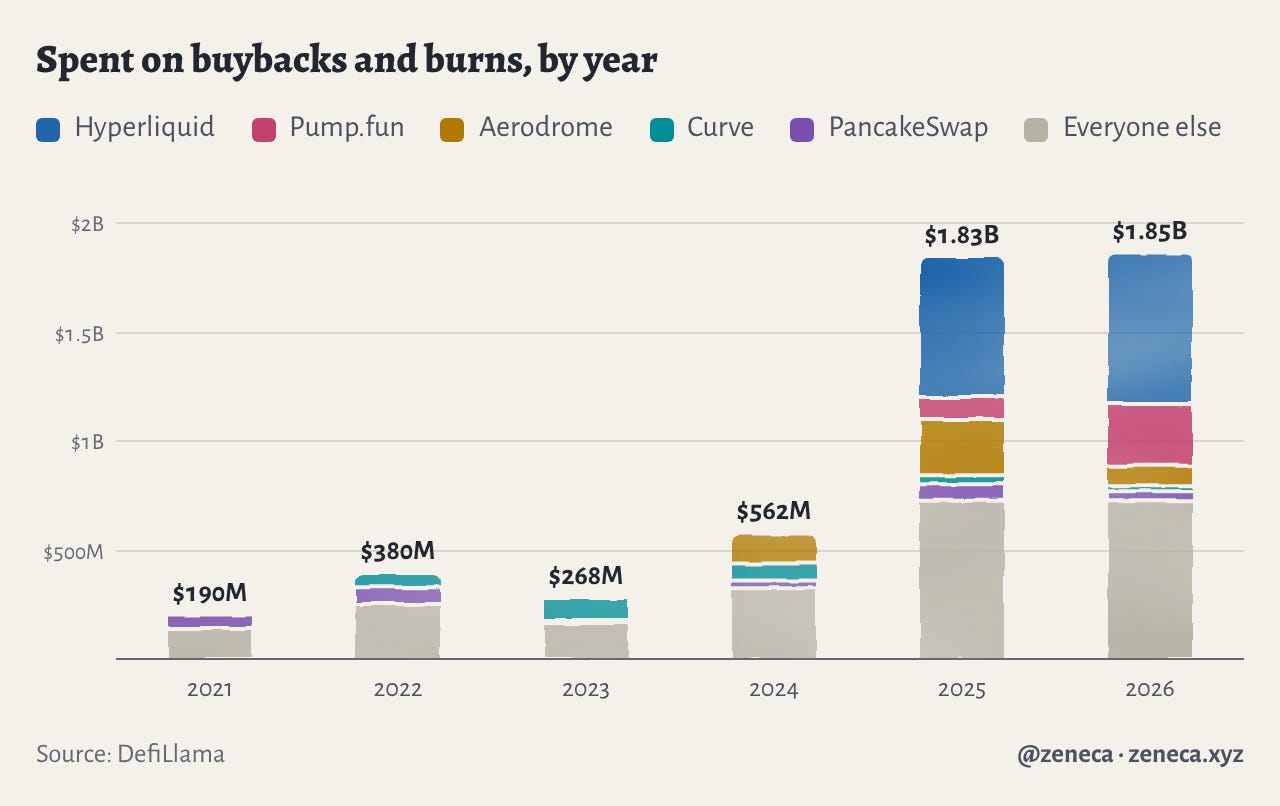
The bit I find most interesting is the last bar. Over the last year the total crypto marketcap fell more than a third, and the money going into buybacks and burns still went up a little. Prices fell hard and the cash kept coming, which is pretty much the whole idea behind value investing.
Ben Graham had a line that Buffett quotes all the time, that in the short run the market is a voting machine but in the long run it’s a weighing machine. For most of crypto’s history there wasn’t anything to weigh, so it was all voting (memes, narratives, whoever had the best Twitter army). I don’t think the voting ever goes away completely, but for the first time there’s a decent chunk of the market you can put on the scales and see some real weight and heft, and I think more of the money is gonna end up there.
What would Ben Graham buy?
Graham wrote The Intelligent Investor in 1949, and Buffett, who studied under him, built Berkshire Hathaway on a version of it. It’s one of my favourite books of all time and I recommend it to everyone. The basic idea is to buy a business for less than it’s worth, based on the money it makes, and then be patient.
Graham’s most famous idea is Mr. Market, an imaginary business partner who turns up every day offering to buy your share or sell you his, at a price that depends entirely on his mood. You don’t have to trade with him or agree with him, you just take his offer when it’s silly. Crypto’s Mr. Market is about as manic as they come. The whole market more than halved between October 2025 and June 2026, and those are the days you want to be buying good businesses.
His other big idea was the margin of safety, which basically means paying well under what you think something’s worth so you’re still okay if you’re wrong. The closest thing I’ve found to a P/E ratio in crypto is the market cap divided by what a project spends buying back (or burning) its token in a year. If a token is worth $1 billion and $50 million a year goes into buying it back, you’re paying 20x. At the time of writing, some of the best run and largest ones (HYPE, JUP, PENDLE and SKY) all trade at around 30x, which gives us a rough line to measure against.
Buffett’s tweak on Graham was “It’s far better to buy a wonderful company at a fair price than a fair company at a wonderful price,” and he once said that if you got a card with only 20 punches on it, one for every investment you’d ever be allowed to make, you’d think much harder about each one and do much better.
A handful of tokens, each one properly understood, is my version of that.
Who actually beat Bitcoin?
I wanted to check all of this against what really happened, so I compared every coin worth more than $300 million on the 11th of October 2026 (100 of them) with Bitcoin. I looked at the past year, and at the whole stretch since the FTX low (or since a coin was first worth $100 million, for the newer ones).
Over the year to the 11th of October 2026 Bitcoin fell about a quarter, and 37 of the 93 coins that were around a year earlier did better than that. The ones that did a LOT better were a pretty mixed bunch. VVV went up about 16x and DRV about 14x, ZEC and XMR rode the privacy trade, HYPE more than doubled, QNT, NEAR, JST and MORPHO were in there too, and so were a handful of small tokens that had only just launched.
But split them into tokens with real buybacks behind them and everything else, and the difference is hard to miss. About six in ten of the buyback tokens beat Bitcoin over the year, against about one in four of everything else, and over the longer stretch it was about half against about a quarter. PUMP roughly doubled what Bitcoin did over the year, and SKY, UNI and RAY all did about 1.7 to 1.9 times as well as Bitcoin.
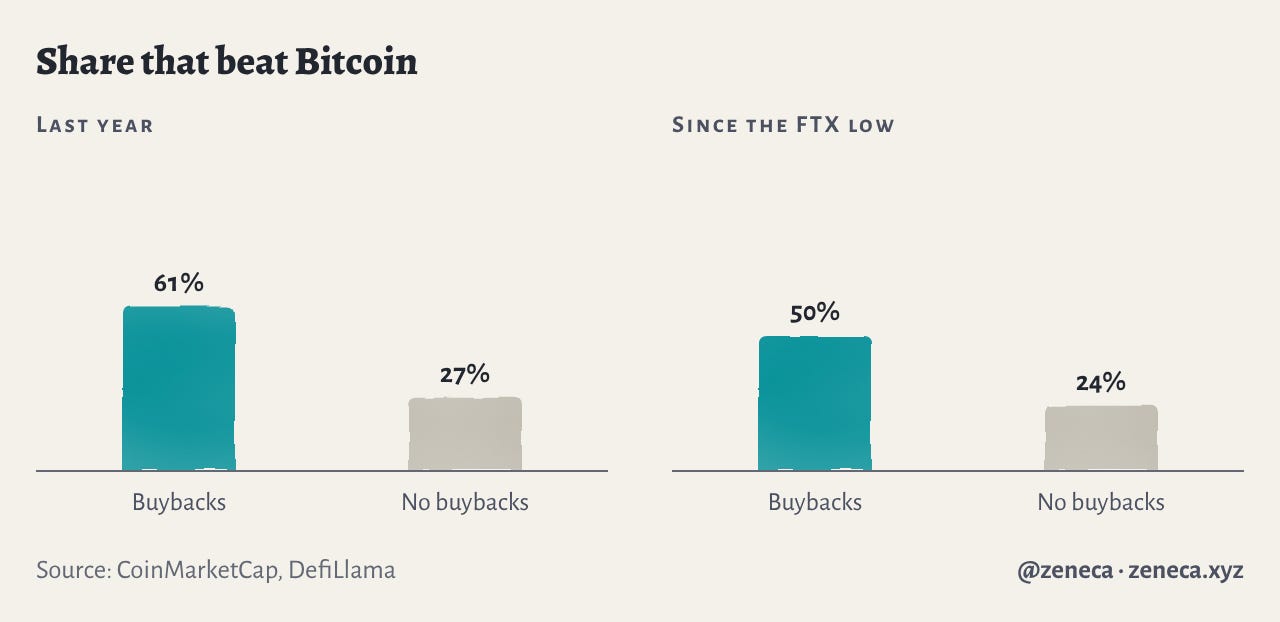
Buybacks aren’t a magic trick though. CAKE and CRV have had them for years and still lost something like 85–90% against Bitcoin since the FTX low, and BONK’s launchpad spends plenty buying it back while the token has lagged behind. The ones that did well were also growing, or cheap for what they were spending on buybacks, or both. And plenty of the biggest winners had no buybacks at all, ZEC being the obvious one.
What jumped out at me most was how cheap some of these got while the businesses underneath kept going, which is Mr. Market at his most generous:
At PUMP’s low on the 25th of June 2026, the whole token was worth about three times what Pump.fun was spending a year on buybacks at that pace. It went up nearly 5x from there.
At its low in February 2026, AERO was worth less than three times a year of fees going to its lockers, and it more than tripled.
At HYPE’s low in January 2026 it was about 11 times a year of buybacks, against about 27 times in October 2026, and it roughly quadrupled.
VVV bottomed at about 95 cents on the 1st of December 2025, when the whole token was worth about $40 million and Venice was reportedly making something like $10 million a year. It went up about 26x.
RAY and UNI both more than tripled from their lows too, and SKY nearly doubled.
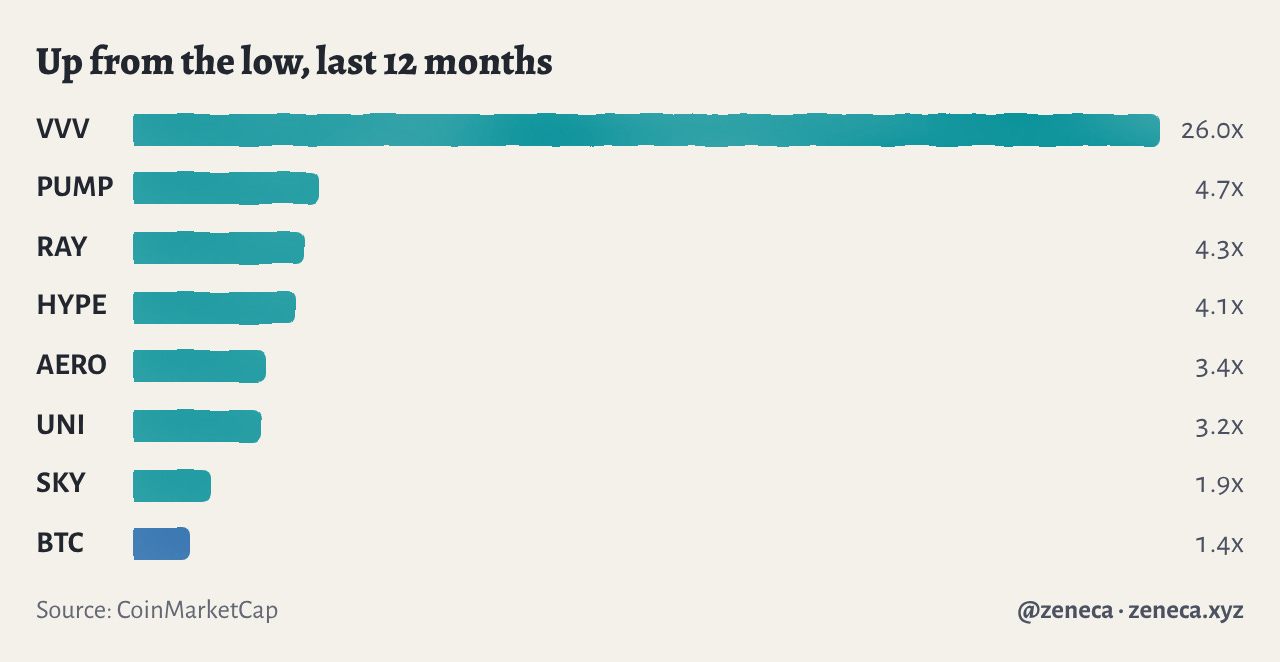
None of those lows felt like opportunities to most people at the time. PUMP’s best buying opportunity came while memecoins were dying, in a bear market, and while the founders were being sued. That’s the whole point of Mr. Market though. The price was at its worst when the mood was at its worst, and the business didn’t much care.
To put all of this another way, with a Buffettism you’ve all heard before: be fearful when others are greedy, and greedy only when others are fearful.
It has historically been hard to get excited about being greedy when others are fearful for any tokens other than BTC. Now, however, we are finally seeing real businesses with revenue we can track and track records we can review, allowing us to start to apply a real value investing lens to crypto investing.
So how do you tell a great business from a bad or average one?
These are the questions I ask, roughly in this order.
Does it make real money?
I mean money from customers. Plenty of networks pay out far more in new tokens than they bring in. Bittensor’s subnets made something like $30 million a year from customers by October 2026, while the network handed out more than ten times that in new TAO, which doesn’t pass this test yet.
How much of that money reaches the token, and does it stay there?
This is where most tokens fall over. Fees are what users pay, and revenue is the part the protocol keeps (most of Uniswap’s fees go to the people providing liquidity, for example). Profit is what’s left after the team, the incentives and any new tokens printed to keep users around, and only then do you get to what goes into the token.
Hyperliquid puts basically all of its revenue into buying back HYPE, and Pump.fun about half of its revenue into buying and burning PUMP. Collector Crypt is a really good business, with its gacha packs bringing in about $94 million of revenue in the year to October 2026, but only about 1% of that went into buying back and burning CARDS.
I love CARDS, and I think it’s a great business and strong token to hold, but it irks me when I see people getting all excited about its revenue figures. Revenue is great, but it’s meaningless alone — you need to know how much of that revenue turns into profit, and how much of that revenue/profit is distributed back to the token ecosystem.
Then there’s what happens to the tokens after they’re bought, which I think gets missed even more. A burned token is gone for good, a token sitting in a treasury can come back later, and a token handed out as a reward or cashback mostly gets sold straight back into the market, so the buying and the selling roughly cancel out.
Brave has only ever bought BAT to pay people for viewing ads, and most of them sell it, so it was never really a buyback at all. And since September 2026, for every two ETHFI that ether.fi buys back, one goes straight out as cashback to card users, and plenty of them sell.
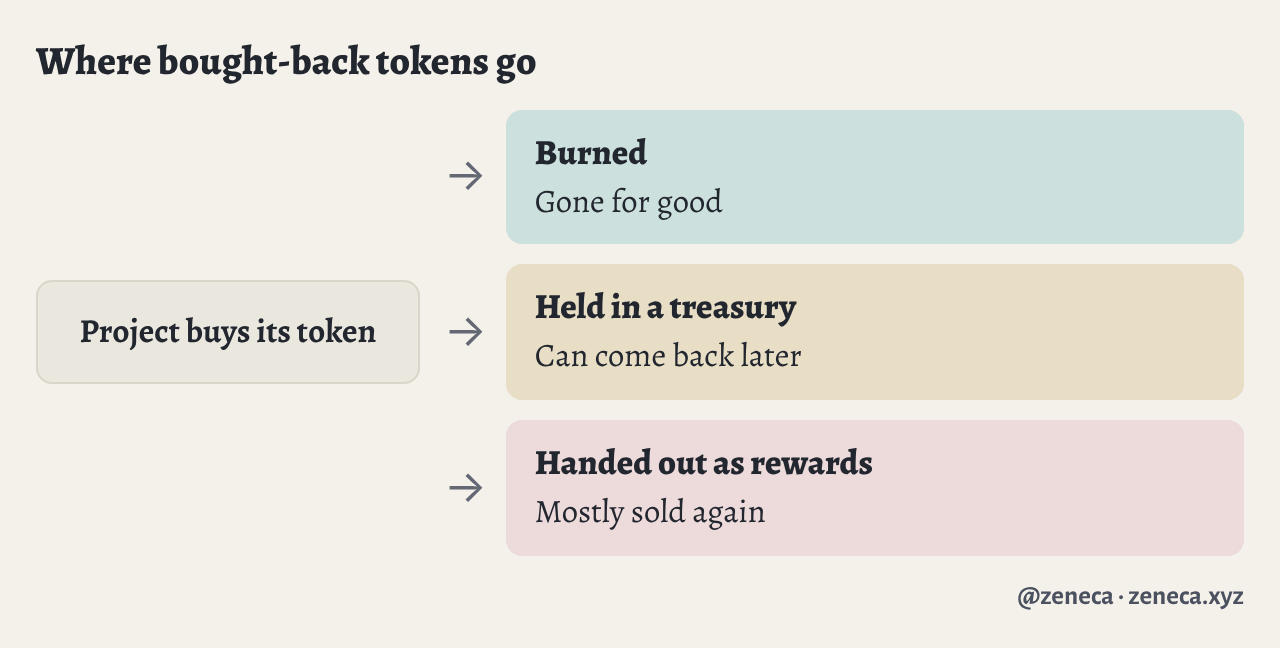
I like both BAT and ETHFI as tokens in spite of this, but just make sure that when a project tells you how much it spent on buybacks, you always ask where the tokens went next.
Do the unlocks eat it?
Buybacks don’t do much if the team and investors are selling you more tokens than the buyback takes off the market. Pump.fun unlocks nearly $40 million of PUMP a month for the team and early investors until mid-2029, so a big chunk of what it buys back is really just soaking up insiders’ tokens. It can still be a strong token in spite of this, but it’s something you have to take into account.
Will it still be here in 2029?
If I’m gonna hold something for years it has to survive the bad years too. Something I say a lot is the only thing you need to do to thrive in this space is survive this space, and that goes for protocols as much as it does for us. While not everything that survives is going to do well (far from it), if a protocol can survive, grow, generate revenue and use some of that to support its token, chances are very good it’s gonna do well.
What about growth?
Value investing gets a reputation for only buying cheap, boring stuff, but Buffett himself wrote in 1992 that “growth is always a component in the calculation of value.” In 1972 he paid about three times book value for See’s Candies, which Graham never would have done, b/c Charlie Munger had convinced him a great business was worth paying up for. By 2007 See’s had made Berkshire about $1.35 billion.
So I’m happy to pay a bigger multiple for something that’s growing fast, as long as the growth is real and the price doesn’t already assume all of it. Derive does most of the onchain options trading there is, its open interest was more than ten times bigger in early October 2026 than a year earlier, and since a vote in October 2026 half of its fees buy DRV every week. At about 48 cents DRV was worth more than 100 times its revenue over the past year, which looks crazy next to the ~30x the best-run tokens trade at.
The way I’d check whether the growth is priced in is to work backwards. For DRV to trade at that same ~30x, with half of fees buying it back, Derive would need fees of something like four to six times its recent pace. If you think that happens within a couple of years, DRV could still look cheap in hindsight, and if it doesn’t, you’ve paid a growth price for something that stopped growing.
And then there’s ZEC
Okay so, ZEC, which breaks just about every rule in this letter. Zcash makes less than $1 million a year in fees, none of it goes into the token, and the new ZEC created every year is worth hundreds of millions of dollars. Buffett would hate it. In his 2011 letter he said you could fondle a cube of all the world’s gold all you like and it would never produce anything, and in 2018 he called Bitcoin “probably rat poison squared.”
Bitcoin is the obvious store of value, and if all you want is to park money somewhere for the long run and sleep at night, it’s the sensible pick and I wouldn’t argue with you. But the whole point of this plan is to do better than Bitcoin, which as we saw right at the top is a lot harder than it sounds, so for the store of value part I’m going with ZEC. Zcash is basically Bitcoin’s monetary rules (a 21 million cap and a halving every four years) with an optional privacy mode, and I think privacy gets more valuable the more of our money ends up on public chains.
It’s got real risks, obviously. With no cash flows at all, the price is pure belief. But Bitcoin has always been pure belief too. Bitcoin is basically the ultimate meme coin, and the memetics around ZEC are sufficiently strong that I feel confident holding it.
What could go wrong?
A lot, as always.
The voting machine can win for a long time. If the next run is a 2021-style memecoin mania, a handful of boring buyback tokens will probably lag while people 50x on stuff with no revenue at all. I’m okay with that, but it’s part of the deal.
Paying up for growth can go wrong if the growth stalls, so I’d keep those positions smaller than the ones already buying back plenty of their own tokens. Buybacks themselves can stop. If a team or a DAO decided to start them, they can decide to stop (as we saw with Aave and Sky), and you usually have no legal claim on the revenue either.
How I’m gonna play it
Putting all that together, this is roughly the plan for the next bull market:
Own a handful of tokens with real businesses behind them, plus a bag of ZEC as the store of value.
Only buy something if I can explain in one sentence how money gets from its customers into the token, and follow the tokens after the buyback.
Check the unlocks against the buybacks before buying anything.
Compare the price with what’s being spent on buybacks.
Pay up for growth only when it shows up in the fees, and work out what the price already assumes.
Write down what would make me sell before I buy, and hold for as long as none of it happens.
Build positions slowly, let Mr. Market’s bad days do the work.
Measure the whole thing against just holding Bitcoin, as that’s the bar to beat.
Final thoughts
The other thing I want to say is that you can’t catch them all, and you shouldn’t try to. There will be great businesses with great tokens that I never buy, and some of them will go up 10x while I’m sitting there holding something boring. THAT’S OKAY.
I’d much rather own a few things I really understand and believe in, put real money into them and give them time, than own a little bit of everything and not know why I own any of it. Find your own handful, the ones you’d hold through a 60% drawdown b/c you know what the business is doing, and accept that you’ll miss plenty of others.
I could go on, but I think that’s the plan. It’s a pretty boring one, and I’m fine with that. In the next letter I’ll go through my actual portfolio and how it’s split up, and after that I’ll do deep dives on the tokens I’m most bullish on and why, breaking down some of the best tokens in crypto based on business fundamentals.
As always, thank you for reading, and leave any questions or comments below :)
Disclaimer: The content covered in this newsletter is not to be considered as investment advice. I’m not a financial adviser. These are only my own opinions and ideas. You should always consult with a professional/licensed financial adviser before trading or investing in any cryptocurrency related product. Some of the links shared may be referral links.