
Today's letter is about trading journals. I started the habit of journaling and tracking my results back as a poker player, and while I’d love to open by telling you I logged every poker session for fifteen years like some kind of spreadsheet monk, the truth is less glamorous. I journaled in stretches. There were months where I recorded everything, and months or even years where I recorded nothing at all. On again, off again, the whole way through my career.
Looking back across those fifteen years, the pattern is almost comically clear. The stretches where I journaled were the stretches where I played my best and won the most. The stretches where I didn’t were the ones with the slow leaks, the bad habits creeping back in, and the downswings dragging on longer than they needed to.
Some of it was that the very act of journaling was making me better. Some of it was the version of me disciplined enough to journal also being disciplined enough to do everything else properly. Honestly, it doesn’t matter which. The lesson was identical either way. When I wrote things down, things went well. When I stopped, they didn’t go as well. It took me an embarrassing number of on-off cycles to accept this.
Then I repeated the whole cycle in crypto, because apparently some lessons need to be learned twice (or five times, or, heck, twenty times). I’ve had periods where I tracked every single trade, and periods where I tracked nothing and yolo traded at high frequencies based on nothing but vibes. Once again, the tracking periods were better. Shocking, right?
So today I am gonna share a bit about what I tracked for poker, what I track for crypto and trading / investing, and then also share a template at the end for anyone to use to begin to do your own journaling.
What I tracked
During the stretches when I did journal for poker, after each session I logged the date, how long I played, and my results, and then a comments column for additional notes. Things like whether I was playing after a big meal, if I was low on sleep, if I had a fight with my partner, if I felt in the zone, etc. Whatever was true went in, no matter how unflattering.
All of it was useful. The comments column especially so, because when I lined it up against the results, the patterns fell out on their own. The low sleep sessions underperformed. Playing after a big meal underperformed. Nothing surprising in hindsight, but there’s a world of difference between vaguely suspecting something and seeing it in your own spreadsheet in your own words. The comments column was quietly building a map of my weaknesses.
And then there were two more columns, which turned out to be the special ones.
The two scores
After each session, alongside everything above, I scored two things. And while I did, I tried to deliberately ignore the results column:

It’s so simple, but it changed everything for me. Believe it or not, it changed everything beyond poker — it changed how I thought about the world.
If I lost money while playing well through a stretch of bad luck, I’d finish the session feeling genuinely good because I got to put a high number in the “how well I played” column. The spreadsheet sat there reminding me the only thing I controlled was the quality of my decisions, and if my decisions were sound, over a long enough timeline things would work out in my favour.
If I won money while playing badly and getting bailed out by the deck, I’d feel a little uneasy. Which was exactly the right feeling to have. A lucky win is the most dangerous thing in gambling and in markets, because it teaches you the wrong lesson at the moment you’re most receptive to learning it.
The two scores moved my emotions onto the things within my control, and away from the things outside it.
Long time readers might remember Letter 24, where I wrote about aligning your emotions with your actions instead of your outcomes. This spreadsheet was the mechanism behind the philosophy. White knuckling your way into caring about process over results doesn’t work, at least it never did for me. You need a ritual. Mine was a spreadsheet, a comments column, and two numbers (and then later on, this entire mindset was bolstered for me by reading Stoic philosophy, and realizing that bright minds had been saying the same things for thousands of years).
Bringing it to crypto
Everything above translates directly to trading and investing, with one adjustment. In poker, you’re constantly making decisions. Every minute or so at one table, and multiple times a minute if you’re playing more than one table at a time. A crypto position might run for months, and even “short term” trades are often at least hours from open to close. So the journal entry happens in two parts, at entry and at exit.
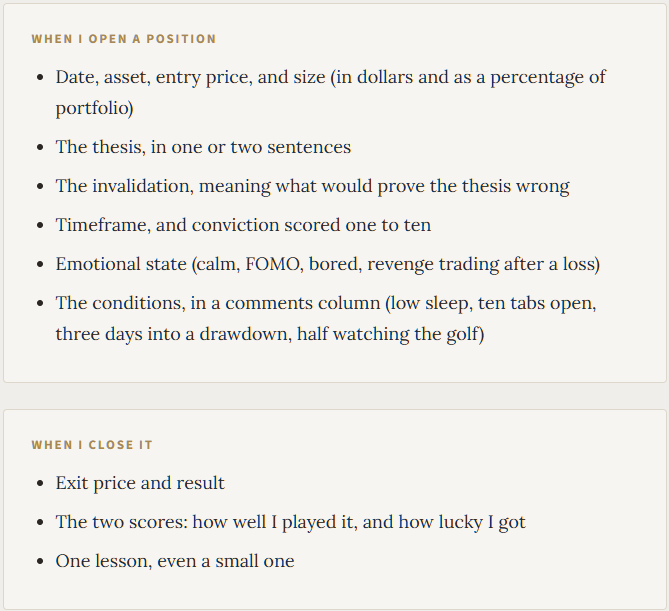
The thesis and invalidation lines do the heavy lifting. If you’re unable to write a two sentence thesis, you don’t have one and shouldn’t be making the trade, so you’ve learned something valuable before risking a single dollar. And a thesis without an invalidation isn’t a thesis at all, it’s just hopium.
The two scores are where the poker magic carries over.
Playing well in crypto looks like: I sized sensibly, I entered according to a plan, I honoured my invalidation, I exited for a reason rather than a feeling.
Getting lucky looks like: an unrelated narrative pumped my bags, a listing announcement I never saw coming, the whole market ripped and lifted everything including my mediocre pick.
After twenty or thirty closed trades, sort your journal by those scores and look at where your profits came from. If they cluster in the high-luck, low-quality trades, you’re not truly winning. You’re being paid to build bad habits, and the market collects on those eventually. It always does. I would much rather know this about myself from a spreadsheet than find out the expensive way, and I say this as someone who has found out the expensive way more than once (because, again, I am a dumb dumb).
You have to be honest
None of this works unless you are brutally truthful with yourself.
“I bought because X was euphoric and I didn’t want to miss out” is a perfectly valid entry. So is “entered this at 1am on four hours of sleep”. They’re also some of the most useful sentences you’ll ever write about yourself, because six months later you get to see, in your own words, exactly what euphoria and exhaustion cost you. Not as a vague feeling where you go “yeah yeah I know I shouldn’t have done those things”, but an explicit number where you can go “oh… oof. ouch, that hurts, maybe I reallllllllllllly shouldn’t FOMO trade”.
Nobody reads your journal except you. There’s no audience to perform for, no followers to impress, literally no reason not to write the whole truth. Lying in your own journal is like lying to your doctor. Technically possible, and entirely self defeating.
Reading it back
Writing the entries is half the habit. Reading them back is the other half, and it’s the part where you actually get to reap most of the benefits of the process.
When I am being disciplined and journaling, my cadence is simple. I’ll take a quick look at the journal every morning. Then once a month I’ll go through and read the whole month in one sitting and look for leaks or patterns or anything that will help me improve future decision making. In poker we called recurring mistakes leaks, and knowing your own leaks is most of the battle.
The comments column is often where they live. Mine, straight from my own entries: I size too small on my best ideas, I struggle to cut positions even when the evidence and my gut are telling me to, and my worst entries happen first thing in the morning (usually because I see some narrative that has run over night, get FOMO, and before I have properly woken up or had my coffee, I have entered a dumb trade). I know all three because they’re written down, in my own words, over and over and over.
I’m always working on improving these things. It’s a constant battle for me, and it will be for you. Once you plug these leaks, you’ll have different ones in the future. One of my biggest leaks a few years ago was struggling to take profits, and fortunately I have gotten a lot better at that in recent years.
The template
To make starting as easy as possible, I’ve built a free template you’re welcome to copy, share, and make your own:
It’s all pretty self explanatory in the read me page. You don’t have to use this, it’s just an example. Some people like doing this with a physical book. I encourage you to make it your own — even if you do copy the template, add things that you want to track, and remove anything that you’re finding unhelpful.
Some journaling tips
Write the entry before the trade, or as soon after as you can manage. Hindsight contaminates everything it touches and if you wait too long, it’s hard to trust what your genuine thoughts were at the time of the trade.
Make sure to use the comments section. Low sleep, too many tabs open, after a fight, after a big meal. They might seem like boring or inconsequential details today, but patterns will emerge over time.
Score every closed trade twice: how well you played it, and how lucky you got. Let those two numbers, not the PnL, tell you how to feel.
Make sure you’re honest with yourself every step of the way. This is for your eyes only, you’re only hurting yourself if you’re not honest.
Read it back monthly (or regularly). Your leaks are in there, written in your own words.
Final thoughts
The goal was never to be happy when you make money and upset when you lose it. Anyone can be like that — it’s our natural, default state. It’s what everyone is. You’re not going to outperform the masses by behaving the same as them.
The goal is to be happy when you decide well, and a little uneasy when you decide poorly, whatever the outcome. Get there and the violent swings of crypto trading lose most of their power over you, and somewhat magically, the results tend to follow.
A journal is one of the best ways to achieve this goal. Not because writing things down is some mystical magical voodoo wizardry, but for the simple reason that your memory is a biased narrator, while a written record isn’t. You can’t trust your memory, but you can trust your past words (again, as long as you were honest with yourself) — I’m hammering this point home because of how important it is.
And speaking as someone who has lived both sides of the coin — both journaling and not journaling — in two different careers now: the journaling periods are better. Start today. Your first entry takes five minutes, and future you, reading it all back a year from now, will be grateful that you did.
Disclaimer: The content covered in this newsletter is not to be considered as investment advice. I’m not a financial adviser. These are only my own opinions and ideas. You should always consult with a professional/licensed financial adviser before trading or investing in any cryptocurrency related product. Some of the links shared may be referral links.