
I’ve been going back and forth about whether or not to write about Prism. The token has been nosediving, attention has dried up, the “community” is out in full force fudding things left right and center, and fewer and fewer people seem to be paying attention.
Ultimately I decided to write this, because Prism is a cool concept, doing novel and interesting things onchain. Whether or not there’s value in buying the token is up for debate, a debate that we’ll evaluate from multiple sides during today’s Letter.
But simply being able to share a cool project with y’all is enough for me. I had a lot of fun researching this Letter, I hope you enjoy reading it.
Prism is the work of an anon who goes by 0xsolazy, aided heavily by another anon who goes by Colby. It went live on Ethereum in late May, and as I write this the token sits at a price of ~$240 with a market cap of ~$1.2m, having previously hit an ATH of ~$6m. PRISM is the base token of an entire, growing ecosystem, with the idea being that the products and services being built will flow back to support the token price in various ways.
How the token works
PRISM is a Uniswap v4 hook. If hooks are new to you, the tldr is that v4 lets a developer attach custom code to a pool so something fires every time a swap goes through. Most projects use a hook as a small helper sitting beside their token, whereas PRISM does the stranger thing of making the hook itself the token.
They’ve also added an NFT layer to it. Every whole PRISM you hold mints you a matching NFT (there is a cap of 5000 NFTs), and each of those NFTs is a 1/5000 slice of the same single liquidity position. Fees drip down to the NFTs in proportion to how many you hold.
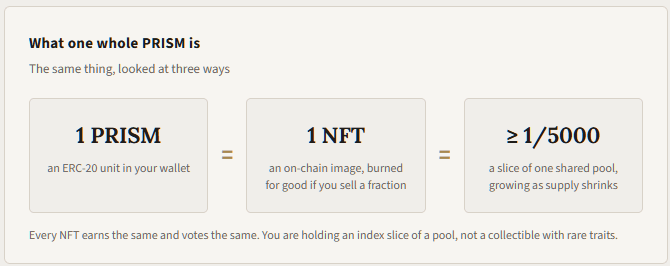
Claiming the fees is open to anyone. They pile up inside the pool, and a single call from any wallet pushes them out to whoever holds the NFTs at the time, split by share, and nobody needs permission to do it.
Where the idea comes from
If this is ringing an ERC-404 bell, good, because the bones are the same. ERC-404 was an early 2024 fad where people fused a fungible token and an NFT collection so the two mirrored each other. PRISM runs on the same mirror trick in its tidier modern form, DN404. It is laid out across a handful of small contracts handling the hook logic, the token-to-NFT syncing, and the art drawn onchain.
The difference from the old 404 projects is the part I like. Most of those were NFTs cosplaying as a mechanism, where the picture was the whole point and nothing sat underneath it. Basically just memecoins with extra steps. PRISM turns the relationship around where the fee-earning slice of the pool is the point, and the NFT is used to assist in keeping track of the ownership and distribution of fees.
The scarcity only moves one way
5000 is the most NFTs there will ever be. Whenever someone sells a fractional amount of PRISM, the NFT underneath it burns for good. Fewer NFTs alive means a bigger fee slice for everyone still holding a whole one.
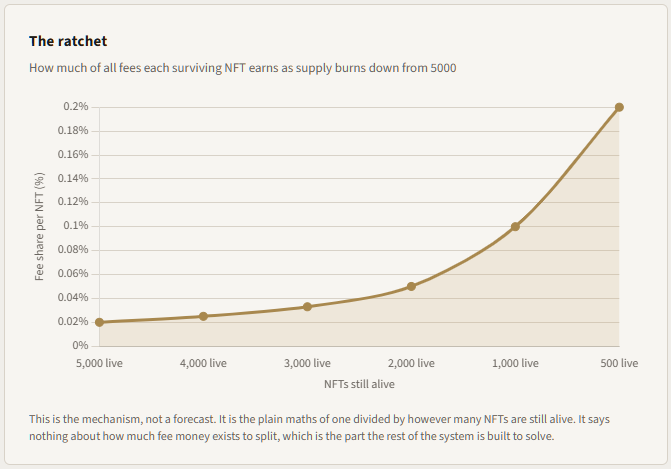
In theory it’s all well and good, but in practice it only matters if there are actually fees to be split. This is the biggest X-factor, and this project will live or die by whether or not the ecosystem is able to generate fees. So let’s look at the various ways that the protocol can currently make fees, and also look at how much has been generated to date.
Spectrum, aka index funds for onchain tokens
This is where things start to get very interesting for me. The base token PRISM is the value capture layer for everything. On top of it sits Spectrum, an index launchpad. Underneath both runs dStable, a yield-bearing settlement rail. Put them together and the pitch grows past hold = earn into something I find more interesting. It is a way to turn a crypto narrative into one thing you buy in a single click.
Let me set up the problem first, because it is one I have lived. Crypto is brilliant at minting narratives. AI agents one week, RWAs the next, then memecoins, then DePIN, then gaming, then Base szn (again), then socialFi, then TCGs, then whatever Twitter decides to care about next. The trouble is being dead right on the theme does not stop you picking the wrong token.
You can be right about the Base AI rotation, then you have to choose between Venice, Bankr, Virtuals, Nock, Rei and a handful of others, and one of them does a 20x while the rest flounder (or simply don’t perform nearly as well). So you end up holding eight or ten tokens to express one view, attention rotates between them, liquidity splits across all of them, and the whole exercise becomes a knife fight between people who already agree with each other.
Traditional markets sorted this out a long time ago. You want a sector, you buy the basket. Onchain has tried the same trick plenty of times and the attempts kept dying, and it is worth knowing why before you assume this one is any different. The old index tokens were two separate things stitched together, a vault holding the coins and a thin little market trying to price the wrapper, and the seam between the two is where they came apart.
You paid a management fee for the privilege, with the category's flagship charging close to one percent a year, roughly 20-30 times a plain S&P fund. The liquidity was rented with token rewards, so the day the rewards stopped the depth walked out and the spreads blew open. And because the wrapper traded in its own thin market, the price drifted above or below the coins it was meant to track, so being right on the call still left you buying rich or selling cheap.
Spectrum's fix is structural. The index trades natively on Uniswap with no separate wrapper market, and its price is bound to the weighted value of the basket by construction, so it does not drift to a premium or a discount. The depth does not walk away when incentives dry up, because the depth is the token itself. And rather than charging you a yearly fee to hold it, the index pays you a cut of its own trading fees for as long as you do. Same one-click, whole-sector exposure an ETF gives you, with the carry running in your direction for once.
Here’s how it works under the hood. Each Spectrum index is its own ERC-20 token, live on Ethereum and Base, a weighted basket with its own v4 hook and a pool paired against dStable, and a redeemable claim on the assets it holds. You buy in with ETH, USDC or dStable (more on dStable soon), and the hook routes your money into the components at their set weights. You get one token back, and it represents your proportional slice of the whole basket. When you want out, you burn the index token and take your share of the real assets at NAV. Own one percent of the supply, redeem one percent of the basket.
The hook handles the buying, the minting, the redemption and the routing, so you skip the spreadsheet and the eight separate trades.
One caution worth keeping in view. A basket takes the pain out of picking the one right token from ten. It does not take out market risk, since a bag of volatile tokens is still a bag of volatile tokens, and an index holding ten low marketcap coins in a new meta will swing wildly.
Now the fee model. Every mint and every redemption charges a one percent fee, and it splits three ways.
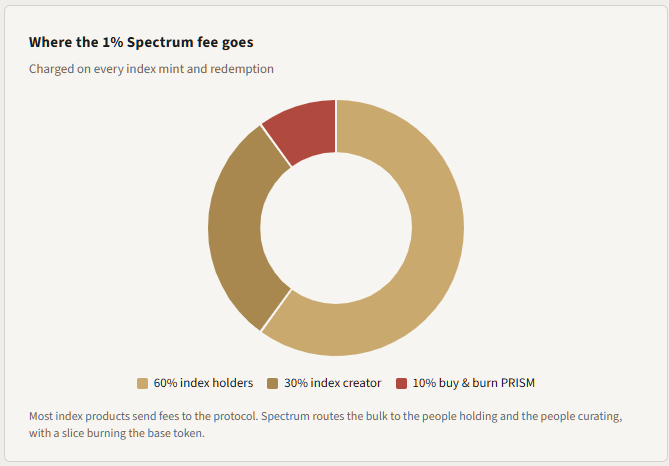
Read the creator line again. If you put together a useful basket, you earn thirty percent of its fee flow for as long as people trade it. Your top picks become a product with a revenue attached. Become an expert in any narrative or sector and launch your own index and earn fees for as long as the index is traded. This turns curation into a real business model, and it is the cleverest social hook in the whole design. We haven’t seen any indexes really take off yet, but all it takes is one for the flywheel to pop off and every KOL under the sun to jump on the bandwagon.
So how do you launch an index?
The process is a little complex right now, which might be why we haven’t seen too many launched. Another reason is the fee. It basically costs 0.1 ETH to launch a token (technically there’s a dutch auction every 10 blocks from 1ETH → 0.1 ETH, but I can’t imagine so many tokens launching that anyone would do anything but wait and pay the 0.1 ETH).
The fee is also yet another way that the protocol supports their token, with 90% of the revenue from index launches going to buying and burning PRISM.
Anyway, to launch a token, basically you go to the launch page on the Spectrum site and follow the instructions in their deploy guide. The gist of it is that you select your tokens and the weights you want for them all and that should be it, but it’s a little clunky and can require some troubleshooting.
The good news is that there’s a V2 of Spectrum coming out soon which should make this entire process a lot more user friendly, so it should look something like this soon:
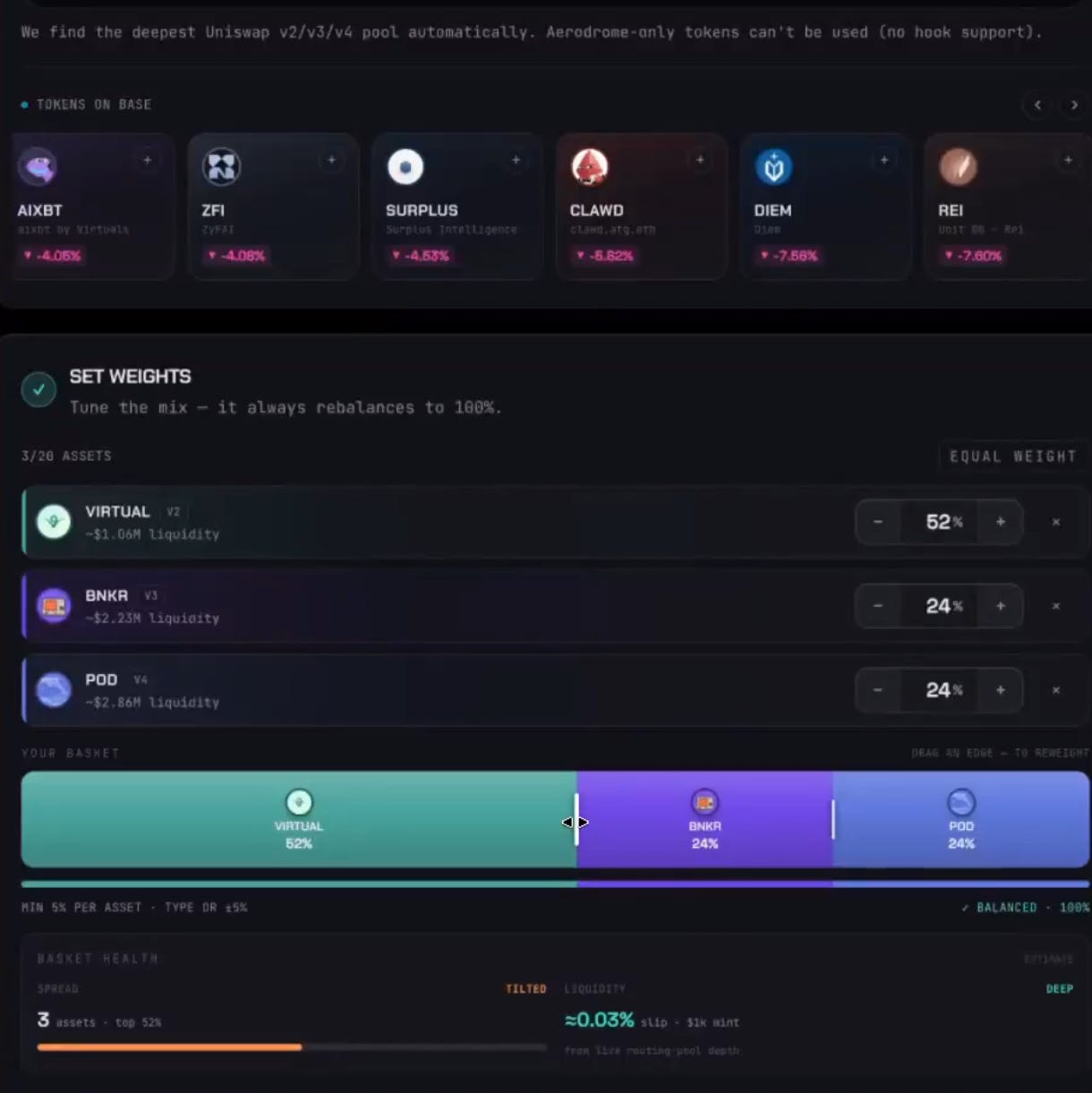
As they say in this tweet, their mission with V2 is to make it as easy as possible to launch an index with a new and improved launch flow that strips away all complexity.
Okay let’s talk about dStable
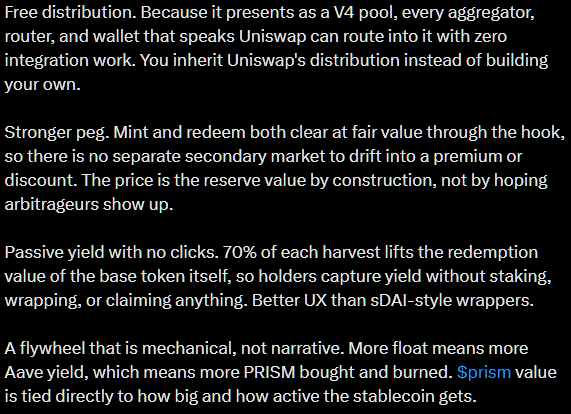
The third piece of the ecosystem is dStable, and it is the least glamorous of the three, which is usually a healthy sign. It is a yield-bearing stable asset, and its job is to be the clean unit everything settles against. Without it, every index has to quote and route through messy ETH paths and multi-hop swaps. With it, Spectrum prices against one steady rail, which makes the system cheaper to use and easier to build on.
The flow is simple. You deposit ETH, the system converts it into stablecoins like USDC and USDT, parks around 95 percent into Aave to earn yield, and keeps a small buffer idle for redemptions. When the yield is harvested it splits three ways. Seventy percent flows to dStable holders, twenty percent buys and burns PRISM, and the last ten percent goes to a dev treasury.
So dStable pulls double duty. It hands you a yield-bearing dollar on capital you parked anyway, and it quietly becomes a second burn engine for PRISM, one that runs off Aave yield rather than trading activity.
There are a lot of impressive elements to how this all works under the hood, and I strongly recommend reading this post by Colby to learn more:


If you can’t be bothered to click and read the whole post, these last few points are at least worth knowing:
Giiifting, and what else might come
I mentioned at the top that PRISM was the base token of a growing ecosystem, with more products and services that will launch and be built on top of it. Giiifts are another one of these, and will be launching soon.
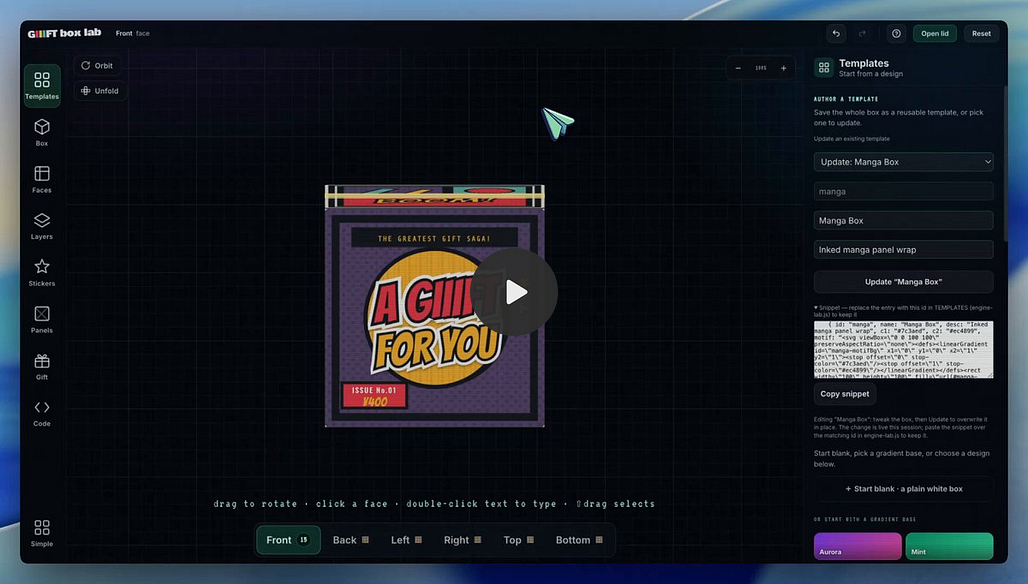
While I think the idea is cool, I’m a little uncertain about how much usage it will actually see. I think most likely once it launches a bunch of people will play around with it and have some fun, but then move on to the next thing, and it won’t gain escape velocity and become a mainstay service. I hope I’m wrong though, and there is a moonshot chance that it really takes off and becomes a narrative in its own right.
Either way, the idea is that using it will benefit PRISM:
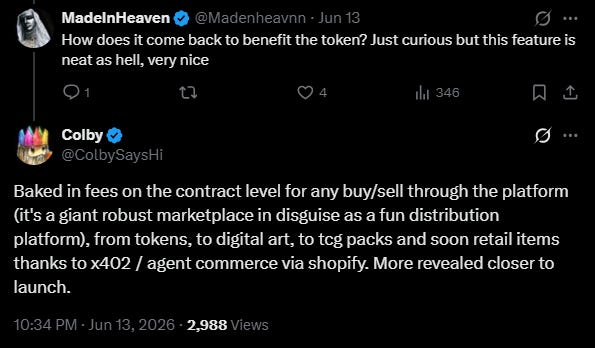
Whether or not this idea works, it’s more the fact that because of the interoperability and composability that we all know and love about blockchains, anyone can build anything they want on top of the Prism ecosystem.
If more builders get excited by the infrastructure, things can really take off.
How’s the revenue actually looking?
A great site for tracking the Prism ecosystem is PrismBeat.
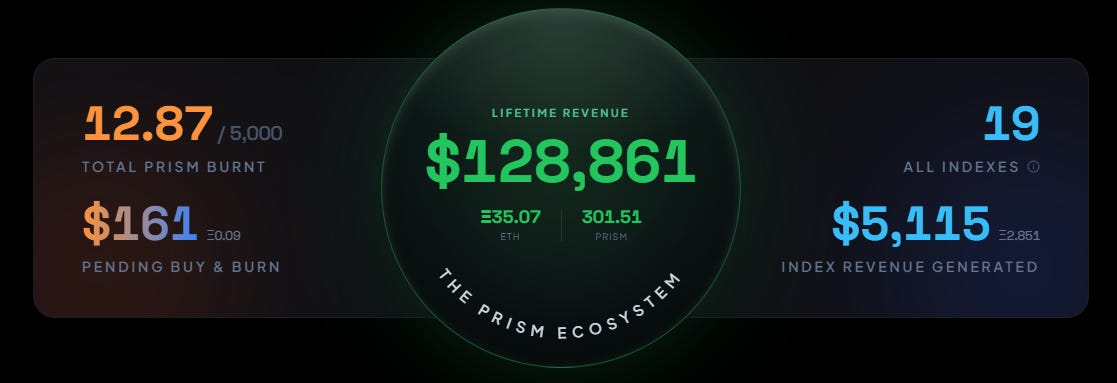
The lifetime revenue is not bad, but most of that came when the token was trading higher and the consensus was a lot more bullish. Volumes have slowed way down, and there was only $3,500 in revenue over the last 24hrs.
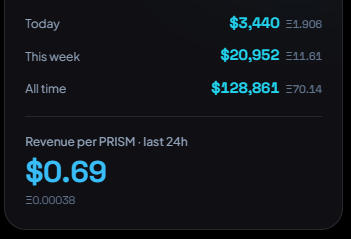
I say “only”, but the math actually works out pretty decently even at these low numbers, with each PRISM token earning its owner ~$0.70 in revenue for the last 24hr period.
70 cents doesn’t seem like much, but when you multiply it by 365 you find that it’s actually bringing in $255.5/yr for every PRISM held. Considering the price of one token (currently $242.91 as I write this), that’s a pretty damn good return, even at low volumes.
If you could be confident volumes would stay at these levels or go higher, then it seems like a pretty obvious buy. We can’t be confident about that though. Things can certainly stay here or go much higher, but as with all things in crypto, they can go much lower too.
One last thing to note is how little revenue has come from the Spectrum / index side of things so far, only around $5k. If that product takes off, then the flywheel is really going to start going crazy. If not, then maybe/hopefully one of the other products does. If not, well, then things start to look a little more bleak.
The bull case for PRISM
PRISM is built to soak up value from the whole system through buy-and-burn pressure as well as fee sharing, and right now it arrives from three live taps, with room for more.
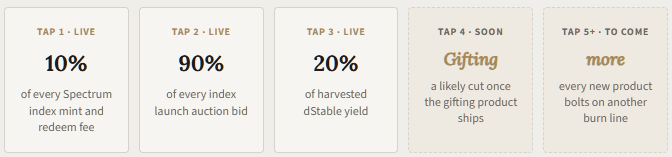
The three live taps are the start. The whole reason to build Spectrum and dStable as separate products is that each new thing bolted onto the system arrives with its own fee, and each fee routes a slice into the same burn. Gifting, once it ships, is a fourth tap. The product after it is a fifth. The more the ecosystem grows, the more lines feed the same sink, and that compounding is the part of the design I find most interesting from a value-capture angle.
It’s sorta like how PunkStrategy works, where every Strategy launched afterwards had a way of tunneling value back to the initial PNKSTR token.
Stack all of the taps on top of the scarcity ratchet from earlier and you get one hell of a potential flywheel. More indexes launch, more people mint and redeem, more fees flow, more PRISM gets bought and burned, fewer NFT claims survive, and the holders left standing own a bigger share of everything.
PRISM is the asset that all captured value flows into.
The bear case for PRISM
While in theory everything sounds pretty freaking incredible for this project, there are many very real, very valid concerns:
The biggest and most recent one is that the main person behind the project has launched it and already moved on to other things. In this post Solazy says he’s working on a cool concept that will be live soon, and it’s unrelated to Prism, which is now primarily developed by Colby and the community.
The Spectrum Indexes are imperfect. A Spectrum basket is immutable once it launches, with no way for the creator to rebalance, so if one of the components dies or gets rugged you are stuck holding it inside the index until you redeem.
Revenue is fairly low across the board. All the fees and buybacks are great in theory, but if volume dies right down, it’ll be tougher and tougher to get people excited.
Complex onchain ecosystems are ripe for being exploited with the recent advances in AI. I continue to be wary of all of DeFi at this particularly vulnerable time, and am mindful of how much of my money I put into any one project.
The v4 hook design is still relatively new, so data tools struggle with it, meaning you will see explorers and charting sites report broken or misleading liquidity for these pools. DexScreener for example will see liquidity = 0 and mark the indexes as suspected scams; not great.
So, plenty to be wary of.
Where I land
This is still early and experimental. What pulls me in is not just the PRISM token on its own, it is the shape of the whole system. The idea of turning a narrative into one basket you buy in a single click, with the people who curate it getting paid and value flowing back to one asset underneath, is a fresh answer to a problem we’ve had for years.
I’m not overly concerned about Solazy moving on to other projects. It’s not great, but it’s bolstered a lot by the fact that Colby has effectively taken on a leadership role. For most projects like these: the techy, cool, interesting ones, you usually need other builders and devs to get excited and get involved for the project to succeed. And while that would obviously help a lot here, I do think the Spectrum product alone is interesting enough to support the ecosystem.
I want to see what the V2 launch is like, and I especially want to see some sort of solution for rebalancing indexes, and solving the problem of creating an index that ends up having a token that rugs in it.
Over my many years in crypto I have seen sooooooo many projects come and go where the tech was genuinely innovative and interesting and the price just never went anywhere. It’s one of the reasons so many people eventually get jaded in this space; the things that go up in price aren’t always the things that “deserve” to go up in price.
I think there’s a very high chance this project, unfortunately, fizzles out. Like, 90-95% chance. If it doesn’t gain momentum, doesn’t generate revenue, and if new builders don’t join and/or Colby decides to move on, then it’s going to be extremely hard to see the protocol thrive.
In this post he mentions multiple teams being added to the ecosystem, and many core products being in flight at the same time:
Which is cool and all, if it’s true (I have no reason to believe it’s not true, but I also don’t have any additional proof that it is).
Anyway, as I said, I consider this a long shot. IF it works out though and if there is renewed, sustained, and consistent attention / building / revenue / etc etc etc, then I think this is the type of token that can do many, many multiples from there. It’s another asymmetrical bet, but one I am pretty comfy and happy making personally.
I don't recommend anyone else make it, but do your own research and thinking, look at your own portfolio and allocations, and if it makes sense for you, dip your toes in.
The Prism ecosystem is one of the more original things I have seen ship this year, heck, probably in multiple years. The design is genuinely clever, and the narrative-as-basket idea is one I keep coming back to.
I find it genuinely cool, exciting, refreshing, and awesome to see out in the wild.
For that, if nothing else, I am happy.
Resources
PRISM contract address: 0xbd3AB5859f244CC9F51Ee0Ca755c5cf663D80040
Disclaimer: The content covered in this newsletter is not to be considered as investment advice. I’m not a financial adviser. These are only my own opinions and ideas. You should always consult with a professional/licensed financial adviser before trading or investing in any cryptocurrency related product. Some of the links shared may be referral links.