
I’ve been ripping a lot of digital Pokemon packs lately. For research purposes, of course. For science. Or, maybe, actually, cause I am a sucker for some fun onchain gambling mechanics with the potential of it being +EV.
I’ve spent the last month watching my life slowly descend into TCG madness. My wife’s brother is staying with us at the moment and he has binder after binder of Pokemon cards and has been collecting them for years. My wife got intrigued, bought a couple of packs when we were at the shops one day, opened them, and was immediately hit with a wave of nostalgia and affection for “the good ole days”.
I felt something similar to that but my vice was always Magic the Gathering, and I quickly found myself pulling out my stash of cards from 20-30 years ago and sorting through them.
Almost every day at home we are now ripping open packs of physical cards and having an absolute blast doing it.
It seems we’re not alone as well. The entire world has seemingly been going crazy for Pokemon, and we find ourselves at the top of an insane bull run in the world of cardboard cards.
I have so many thoughts and things to share on this topic. It reminds me a lot of NFTs. Surely it’s a bubble, surely it will burst spectacularly at some point. Surely it’s entirely unsustainable. But, also, maybe there’s still time to capitalize on the upside?
It’s a risky game to be playing, but my thesis is that there just might be a few more months of mania left — and we all know that the last few months of a speculative bull run are always the craziest.
There are a lot of ways to get exposure to this sector but since I am a crypto person, I will be specifically talking about the onchain avenues for exposure. What platforms you can be using, how you can use them, what airdrops you may or may not be farming, what tokens already exist out there from the higher marketcap to the truly speculative bottom-of-the-barrel meme-stuff, to everything in between.
Settle in cause this is gonna be a doozy, but by the end you should hopefully have a solid understanding of what a potential onchain TCG meta might look like, and what tokens I am currently allocated in.
Remember that the mania is physical first
Before we touch a single token, you have to understand the physical side of things, because none of the onchain stuff works without it.
Trading cards stopped being “just a kid’s hobby” a while ago. The global TCG market is projected to hit roughly $15.1 billion in 2026, with Pokemon making up the bulk of that. 2026 is also the year of Pokemon’s 30th anniversary, and The Pokemon Company (TPC) and community are treating the release of the 30th anniversary set as a massive occasion.
TPC says it has produced 85 billion trading cards since inception, and roughly 10 billion of those (about 12% of every Pokemon card ever made) were printed in the last financial year alone. Demand is (currently) so far ahead of supply that they’re printing at a pace that would have been unthinkable a few years ago, and it’s virtually impossible for people to get their hands on the things they want. Stores sell out to preorders, and there are lines dozens or hundreds of people long waiting to get their hands on the latest drops whenever supply does hit the shelves.
This, to me, once again screams “top” and “bubble”, and I am sure that we will eventually hit an inflection point where the music stops. But for now, let’s allow ourselves to succumb to the delusion for a while longer. I personally think the market won’t cool off until at least the 30th anniversary drop (in mid September), but I am also treating that as a date when risk is at its maximum level (rather than at like an 8/10 level it might be at now).
What “onchain TCG” actually means
TCG means Trading Card Game. Pokemon is a trading card game. MtG (Magic the Gathering) is a Trading Card Game. One Piece is a trading card game. There are many more.
In the context of onchain TCGs, and of collectibles, you can basically eliminate the G part of it all. These are trading cards, treated as collectibles and financial assets — not many people are actually using them to play the game (MtG is the big exception, and it’s probably why not many people invest in MtG cards the same way they do other cards).
When it comes to trading these physical cards, there are real limitations. There are liquidity issues, shipping costs, high marketplace fees, fears of frauds or fake cards, and so on. Being in Australia, it’s not that easy or simple for me to buy the cards I want without having to deal with expensive shipping costs (and customs fees).
Bringing the cards onchain solves most if not all of these issues.
The way it works is a platform buys real, graded cards (PSA, CGC, BGS) and stores them in an insured vault. Each physical card gets a matching NFT. You can hold the NFT, trade it instantly 24/7, or redeem it to have the real card shipped to your door. The card never has to move for ownership to change hands*, which is the entire point.
*the big asterisk obviously being that these are not fully self-custodied NFTs in the sense that there’s still trust involved — you trust in the company (or companies) that are storing and securing these assets and that everything will work as-intended when it comes to transferring ownership via the NFT and when it comes to redeeming the assets.
Nonetheless, these online platforms are doing a spectacularly good job of driving liquidity onchain. They are buying massive amounts of cards to store in their vaults in order to improve the liquidity of their marketplaces, and they have also introduced gacha (gambling) mechanics into the whole system too.
The engine that drives almost all the volume are these gacha machines. You pay a fixed price (anywhere from $1 to $1,000 depending on the machine) and pull a random card from a pool. It's a digital pack rip. All top platforms publish the odds and the expected value, and most offer an instant buyback, usually around 85% to 90% of the card's market value, so you can cash out the second you pull if you want.
A word of warning: most sites will advertise that the expected value of a gacha opening is higher than the cost of the pack itself, ie, pay $50 and get $53 in value back. While that might be strictly true if you’re considering the fair market value of what you get, most of the time what you get is highly illiquid, and you’re better off selling it back to the platform at the 85-90% discount, which, after their own marketplace fees, means you’re definitely losing money, on average, every time you play the gacha game. *exception again is that you might make up the value with a future airdrop, or if you hold the cards and they go up, but both are just more levels of speculation baked on top.
A look at the numbers
Volume is really starting to take off on these platforms:
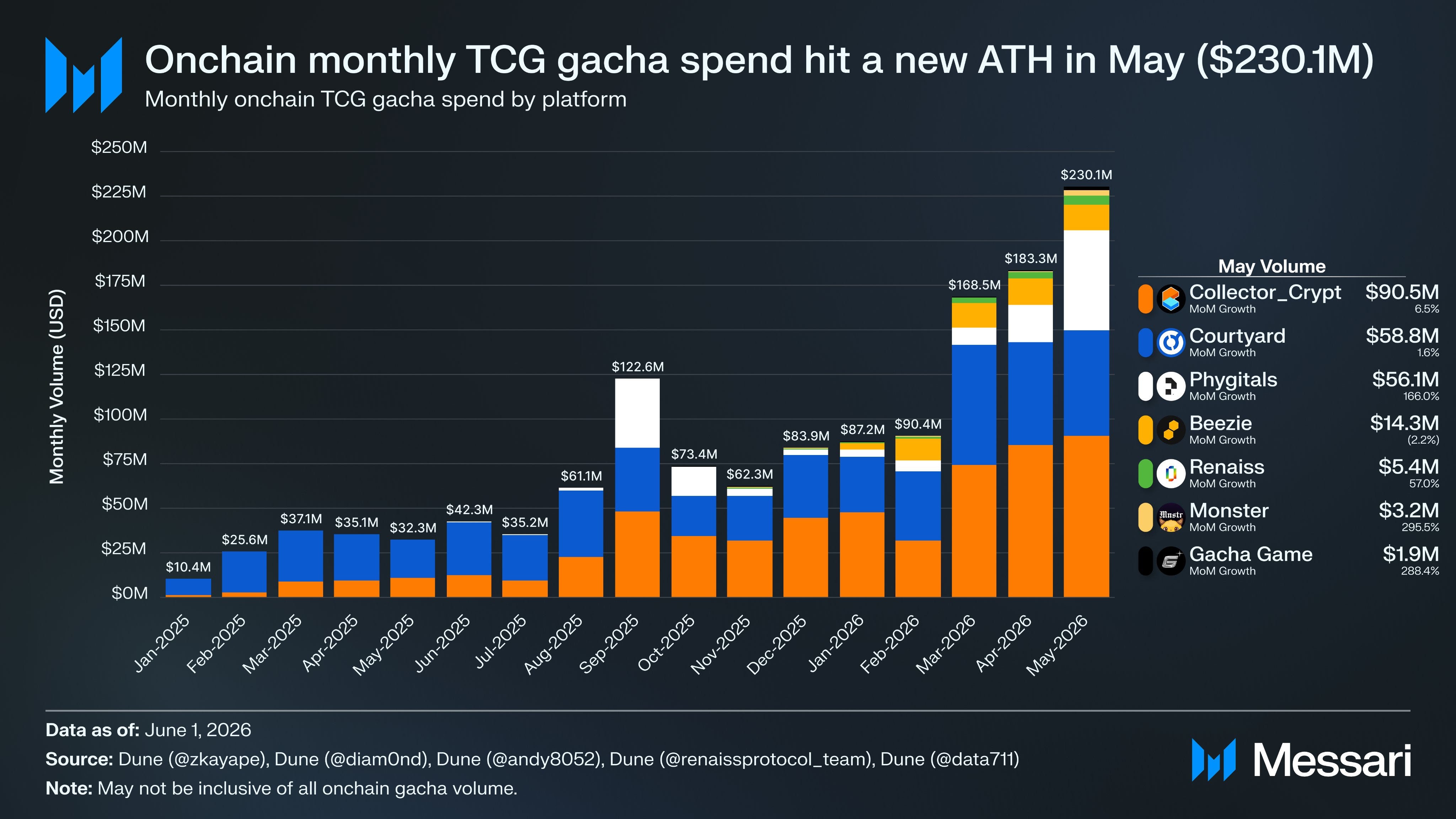
From about $10.4m in January 2025 to $230.1m in May 2026. That's a 22x run in seventeen months. It hasn't gone straight up (notice the cool off late last year), but the trend since March has been relentless, with each of the last three months setting a new record.
We’re also seeing more and more new platforms pop up and it’s worth keeping an eye on them and their volume, especially for potential airdrops if you can get in early.
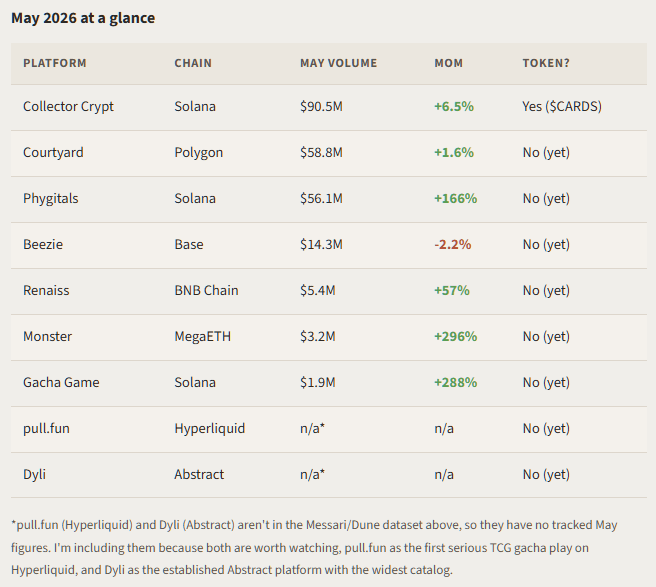
As you can see, most of the platforms have yet to drop a token. I don’t know whether they will all be dropping one, but some of them surely will, and if this meta continues and the volume continues to go up up and away, there are surely some excellent airdrop farming opportunities to be found in this sector.
The Larger and Established Platforms
There are 4 platforms that stand head and shoulders above the rest in terms of volume:
They all operate in largely the same way. Deep marketplace liquidity that is growing at a rapid pace, gacha machine style pack openings that you can do from $25 to $1000, automatic buy-back offers of 85-90% of the value of your pulls.
Beezie is the smallest of the set but they have been around for years and have a strong reputation within crypto, so it very much deserves a spot amongst the top dogs.
Collector Crypt has their $CARDS token that has been on a tear lately, and we’ll dive into the token a bit more in the next section. Courtyard, Phygitals and Beezie are all running points/XP programs which should, hopefully, lead to a nice airdrop in the future, but we have all been burned by protocols farming users for points ad naseum so I always take these things with a giant grain of salt now.
Still, probably worth chunking through a bit of volume, and great platforms to explore if you’re genuinely looking to collect some cards.
The Up-and-Comers
These are the newer platforms that are growing fast but are still only churning through a fraction of the volume of the giants. I think these represent some of the best potential airdrop opportunities since you’re getting in at a much earlier stage and competing with far fewer people at this point. The risk with these though is that they never reach escape velocity and either don’t launch a token, or they launch one but it doesn’t get valued particularly highly.
These all operate in basically the same way and take the same approach as the bigger platforms, although some also have their own spins on things. Also, as I was researching this post, I found more and more and more of these platforms. I had to stop adding them at a certain point. I think we’re going to see many more pop up and try and ride the hype train, and I think a good general strategy is to try and use the ones that have been around a bit longer.
I’m not gonna do a deep deep dive on every platform individually (though if there’s sustained interests and people want that for next week, maybe I can do a follow up).
One thing to be aware of with ALL of these platforms is that.. the odds are stacked against you. Take a look at this chart of the top gacha machines, ranked first by EV and then by Gross EV:
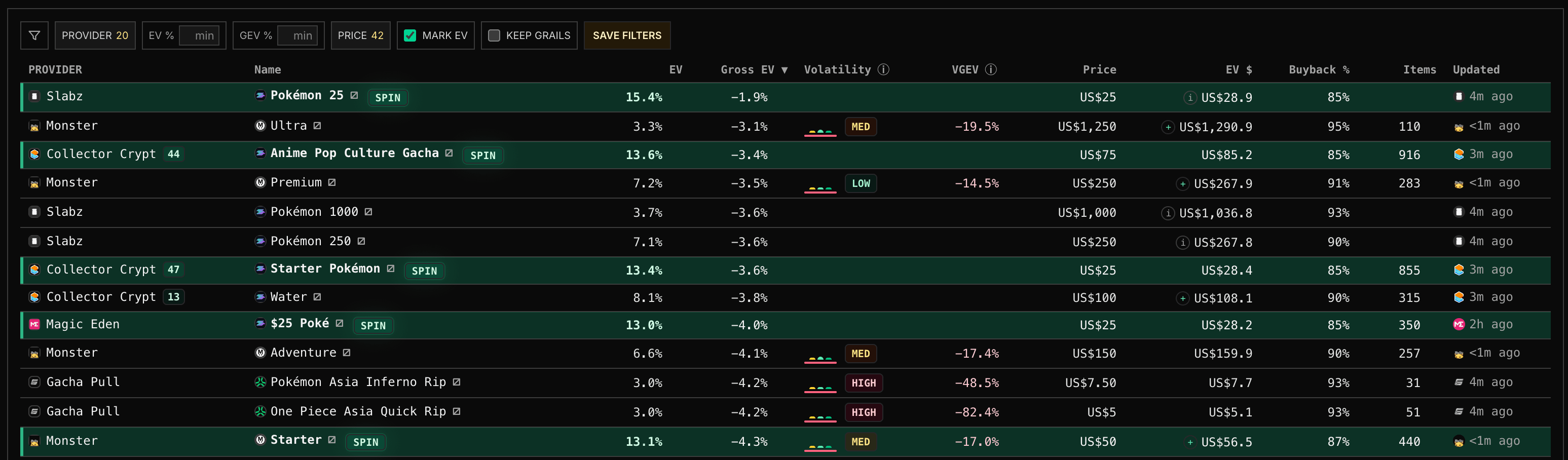
Generally speaking, if you’re playing the gacha games, you’ll want to pick the ones with the best EV (overall if you’re planning to hold the cards, gross if you’re planning to sell most of them back).
EV is what they will advertise on their websites. “Oh look, our $50 gacha machine has an expected return of $53.06!!!” — sounds great, right?!
There’s some truth to that, in the sense that the actual fair market value of the items you win might be worth slightly more than the cost to play the game. But the vast, vast majority of things you’ll win are non-grails, non-highly-sought-after items, and if you actually tried to sell them on your own then you’d most likely lose money.
The Gross EV looks at the 85-90% buyback offer the platforms offer to instantly buy the cards back off you for, and is mostly what you should be looking at.
A gross EV of -2% or -3% means that for every $100 worth of spins you’re doing, you’re losing $2-3 on average.
On the plus side, having real odds known up front is a bit of a welcome change. It’s not such a bad price to pay for some fun, for the chance at winning something big, and especially for the chance of winning an asset that you think might appreciate in price and that you can now hold a secure digital version of.
On the down side, it’s still gambling and “the house” is still gonna win. So, gamble responsibly. I think everyone can win together for some amount of time — in a bull market (even a micro bull / isolated bull, within a macro bear) then things can get silly for longer than anyone might expect.
But eventually the music has to stop and when that happens, you don’t want to be left holding the bag.
Tokens that give you exposure to this sector
Everything up til now has been talking about things at the platform and airdrop farming level. Truth be told, there aren’t too many fantastic ways to get exposure to this movement aside from buying individual cards yourself as investments. That’s probably a decent strategy if you know what you’re doing / can take the time to research, but it’s not the approach I am really taking myself.
For starters, I think that outside of a very very very small percentage of cards, almost everything is WAY overpriced right now. Buying in at these prices feels like a recipe for disaster, especially given the general illiquidity of cards.
So, instead, I am choosing to find second order plays to get my exposure. It’s still risky, just risky in a different way, and in a way I personally understand a bit better and have more experience with. Namely: onchain tokens.
The conversation has to start with $CARDS here, the token behind Collector Crypt.
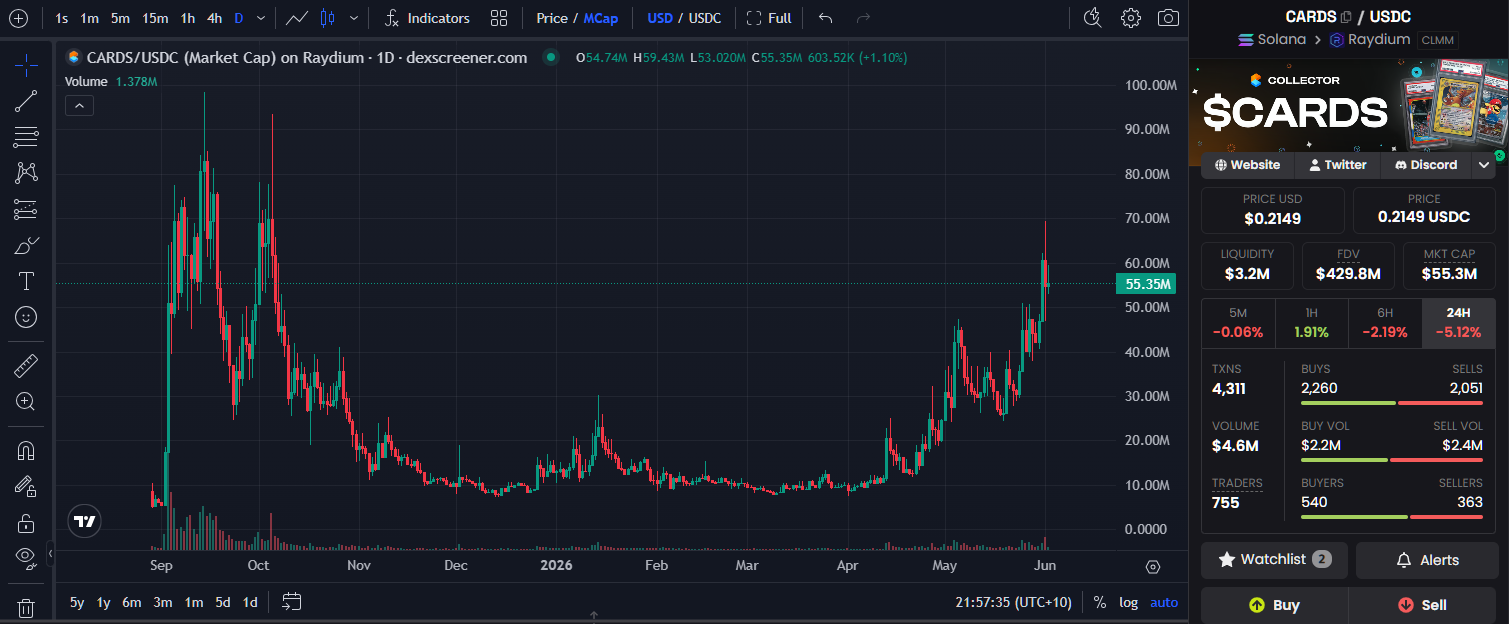
It sits at a $55m marketcap with an FDV of a whopping $430m. That initially scared me off and I had little interest in buying into a token that had such a massive supply overhang, especially since there was no current mechanic for using revenue to buy back the token or support the token price.
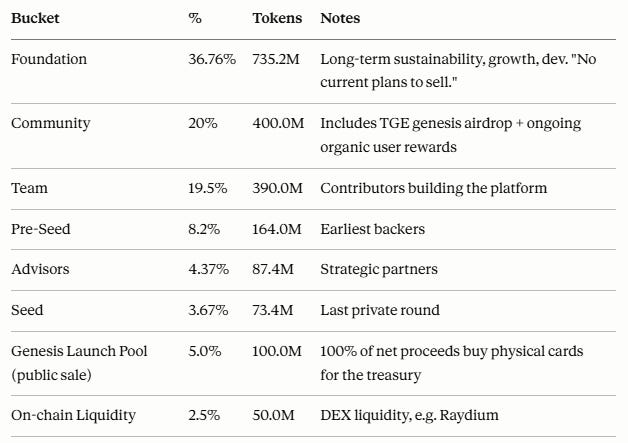
This looks kinda bad, but as I looked into it more however, my fears started to subside.
The Foundation tokens are earmarked for longer term holding and growth and the team has indicated no intention to sell those any time soon. The pre-seed unlocks have already started, vesting 14m tokens per month, and will run until August this year. This is the most significant sell pressure, but the market has proven an ability to shrug them off and continue to go up in price as the unlocks occur.
I believe the team unlocks only begin next year, and that’s a bridge to cross as we approach it. I am really looking at this TCG meta as a trade between now and September or so, and I don’t think the tokens entering the market between now and then are significant enough relative to the revenue the protocol is making + the marketcap to deter it from being a reasonable investment.
They are also positioning themselves to be the “Hyperliquid” of TCGs, wanting to be more protocol than platform. It’s some good marketing, but how much truth is there to it? Hard to say at these early days but there’s some signs of life with other projects building on top of them and tapping into their liquidity to build out their own projects.
Thus, $CARDS is the best way to get exposure in size to the sector. I own a healthy position now and am comfortable holding through the next few months. It’s worth noting that I am not “early” to this trade. It has already done a 5x from the lows, and some people are choosing this as their time to exit the trade.
My logic is that this becomes a strong trade IF the overall thesis of the whole onchain TCG meta continues to evolve and play out as I am thinking/hoping it will: with continued significant growth and mania, going hand in hand with the IRL mania in the trading card world.
Alright with CARDS being the main player in this space, let’s now take a quick look at some of the smaller cap plays — even higher risk, but potentially higher reward.